·expansion MAJOR
Citadels - Upwell Structures
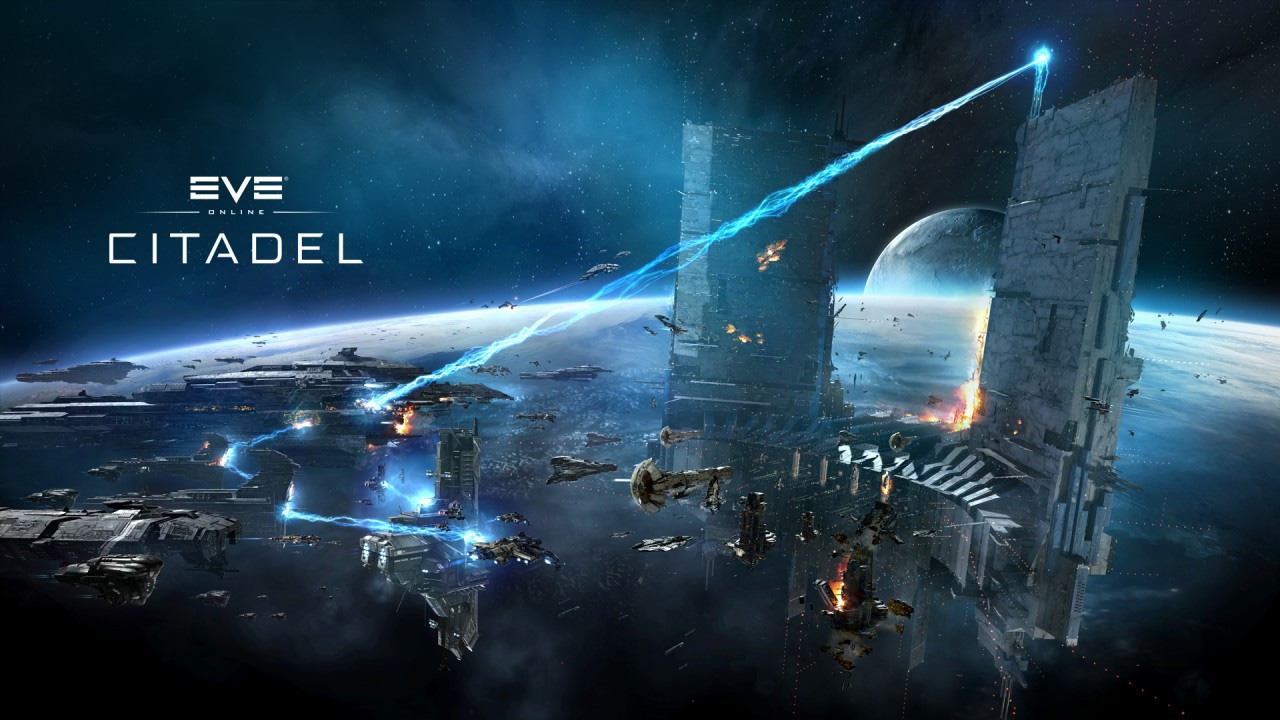
Image: CCP Games · Fan-content policy: https://www.eveonline.com/news/view/eve-online-fan-content-policy
Player-owned Upwell platforms (Astrahus / Fortizar / Keepstar) launch, beginning the multi-year replacement of legacy POS towers as the player-infrastructure layer.
Citadels - what changed
Background
EVE Online: Citadel shipped on 27 April 2016 and is the largest single infrastructure expansion of EVE's modern era. Upwell Citadels - Astrahus (medium), Fortizar (large), Keepstar (XL) - replaced the POS-and-Outpost duo that had defined nullsec staging since 2007. Asset safety made losing a structure financially survivable for the first time. The new Force Auxiliary capital class reshaped fleet logi composition. The Keepstar's XL doomsday became a positional fleet primitive that drove every major structure fight from X47L-Q (2018) through M2-XFE (2021).
If you walked away from EVE in 2014-2015 and you only catch up on one expansion, this is the one. Citadel is the infrastructural prerequisite for almost every interesting late-2010s political event - from highsec small-corp basing to wormhole Keepstar evictions to the Casino War's WWB1 finale.
What changed, by playstyle
PvP
Citadel is the patch that introduced Upwell structures and changed the architecture of nullsec PvP. If you came back from 2014, your mental model of "alliance staging = a POS" is wrong: alliances now stage out of citadels, with onboard fitting / repair / market / cloning services and docking for everything up to titans (in Keepstars). The capital-class Force Auxiliary (FAX) became the dominant logi anchor; the supercap meta shifted from tank-fit supers to fighter-squadron supers; the doomsday-on-Keepstar mechanic added a new positional primitive that drove every major structure fight from X47L-Q to M2-XFE. Asset safety meant "losing your stockpile" became "paying a recovery fee", which in turn changed the risk calculus of nullsec stockpiling. These changes compound: every late-2010s PvP doctrine downstream of Citadel has Upwell-shaped fingerprints.
PvE
Citadel's PvE story is mostly infrastructure - the same NPC missioning loop you remember from 2014, but anchored on a citadel instead of an NPC station, with the financial model shifted from "pay broker fees to NPC corp" to "pay structure fees to whoever owns the citadel." For solo highsec missioners, the practical change was that the closest citadel to your mission area is often a much shorter trip than the closest NPC station, and citadels offered onboard fitting and clone-bay services that NPC stations charged more for. The capital-PvE additions were small in 2016 but seeded the more substantial capital-PvE content that arrived with Lifeblood (Blood Raider Shipyards) and Into the Abyss.
Industry
Citadel is the second pillar of the post-Crius industry rebuild (the first being Crius itself in 2014, the third being Ascension's Engineering Complexes seven months later). The structure-vs-POS calculus inverted: for serious industrialists, POS infrastructure became a legacy choice, and Astrahus / Fortizar reprocessing arrays delivered the post-Crius 100% efficiency cap that NPC stations couldn't reach. Asset safety made centralised nullsec industrial stockpiles viable for the first time - losing the citadel no longer meant losing the assets. Capital build pipelines moved into citadels (with Sotiyo Engineering Complexes coming later in 2016 to optimise this further). If you walked away in 2013-2014 and never used Crius, the catch-up arc is Crius -> Citadel -> Ascension EC -> Lifeblood Refinery, in that order; Citadel is the structural inflection point where "alliance industry" moved from POS-clustered to structure-anchored.
Social / political
The political and social impact of Citadel was layered. Highsec citadels meant small corps and casual alliances could anchor structures with services for the first time, ending the long-running "NPC station or POS-in-lowsec" binary. Old nullsec Conquerable Outposts started losing relative value (full conversion to Faction Fortizars happened mid-2018). Renter-empire economics shifted toward "rent a citadel with services" rather than "rent system access." Wormhole groups began the move from POS-only staging to citadel-and-POS hybrid, which eventually produced the WH Keepstar story - Inner Hell's J135031 was the first WH Keepstar destroyed (July 2017), and Hard Knocks's Fort Knocks was the most-iconic WH Keepstar destruction (December 2018).
Aftermath / what stuck
The structure-rebuild story has three subsequent layers - Engineering Complexes (Ascension, November 2016) for industrial production at scale, Refineries with active moon mining (Lifeblood, October 2017), and the full Outpost-to-Faction-Fortizar conversion in mid-2018 - but Citadel is the spine. Nine years later, the Equinox sov rework (June 2024) is still operating against the Upwell substrate Citadel laid down. The 2016 M-OEE8 Keepstar destruction (December 2016, eight months after Citadel - first fully-armed Keepstar to fall, the WWB1 finale), the 2017 first-WH-Keepstar destruction (Hard Knocks's J135031), the 2018 X47L-Q Keepstar fight, the 2020 FWST-8 record-breaker, and the 2021 M2-XFE Titan massacre are all downstream of one decision: that alliances could anchor feature-rich structures anywhere in space.
What changed for you
compare across expansions ->Top picks · highest impact across all playstyles
-
5
PvP
Upwell Citadels (Astrahus medium / Fortizar large / Keepstar XL) shipped - anchorable structures with services, fittings, and onboard repair, replacing the POS infrastructure that defined nullsec staging since 2007; for the first time alliances could place feature-rich structures in any sec space, including highsec.
-
5
Industry
Player-anchored citadels with reprocessing arrays meant nullsec coalitions could finally hit the post-Crius reprocessing efficiency cap of 100% in their own infrastructure, rather than relying on POS modules; the structure-vs-POS calculus inverted overnight for serious industrialists.
-
5
PvP
Asset safety mechanic was introduced - when a citadel is destroyed, contents enter a recovery system rather than dropping as loot; structurally rewrote the risk calculus of stockpiling assets in nullsec, since "lose the keepstar, lose your stockpile" became "lose the keepstar, pay a recovery fee".
All changes by playstyle (16 changes across 4 playstyles)
-
5
Upwell Citadels (Astrahus medium / Fortizar large / Keepstar XL) shipped - anchorable structures with services, fittings, and onboard repair, replacing the POS infrastructure that defined nullsec staging since 2007; for the first time alliances could place feature-rich structures in any sec space, including highsec.
-
5
Asset safety mechanic was introduced - when a citadel is destroyed, contents enter a recovery system rather than dropping as loot; structurally rewrote the risk calculus of stockpiling assets in nullsec, since "lose the keepstar, lose your stockpile" became "lose the keepstar, pay a recovery fee".
-
4
Capital ship class Force Auxiliary (FAX) was introduced - a new triage-capable capital logi class (Lif / Apostle / Minokawa / Ninazu); FAX hulls replaced carriers as the dominant capital-fleet logi anchor and reshaped capital fleet composition for the rest of the decade.
-
4
Keepstars introduced doomsday weapons usable from a structure platform - the XL doomsday becomes a positional fleet primitive instead of a titan-only capability, and Keepstar siege fights gain a new doctrinal layer that drives the X47L-Q / M2-XFE meta.
caveat
The doomsday-from-Keepstar mechanic was central to the X47L-Q fight (2018) and the M2-XFE Titan massacre (2021) - see the Phase 2 Step 2 battle entries
2018-08-x47l-qand2020-12-m2-xfefor downstream context. -
3
Capital ship rebalance pass: dreadnoughts, carriers, and supercarriers got reworked role bonuses, with carriers losing their direct-damage role to fighters-as-drones and supers gaining heavy-fighter squadrons; the "tank-fit super" meta was nerfed materially.
-
3
Citadel-anchored PvE became viable - onboard repair, market, and clone-bay services let highsec missioners base out of a player citadel rather than an NPC station, lowering jump-clone overhead and undercutting the NPC-station-only-PvE pattern.
-
3
New capital PvE encounters were added - the Citadel patch added the first NPC encounters specifically tuned around capital ships, expanding capital usefulness beyond pure-PvP applications.
-
2
T1 industrial ship rebalance gave capacity tweaks across all four racial industrials - minor in isolation, but combined with citadel-anchored services, materially changed missioning logistics.
Industry
Industry across all expansions ->-
5
Player-anchored citadels with reprocessing arrays meant nullsec coalitions could finally hit the post-Crius reprocessing efficiency cap of 100% in their own infrastructure, rather than relying on POS modules; the structure-vs-POS calculus inverted overnight for serious industrialists.
-
4
Capital ship build pipelines moved into citadels - Engineering Complexes had not shipped yet (those came with Ascension in November 2016) but the pre-EC era of capital builds in citadels established the pipeline shape that Sotiyo would later optimise.
-
3
Asset safety dramatically reduced the risk of stockpiling minerals or BPOs in deep nullsec citadels - losing the citadel no longer meant losing the assets, which made nullsec industrial centralisation viable for the first time.
-
2
T1 industrial ship rebalance combined with citadel-anchored fitting services meant industrial-ship doctrine choices became more granular - the capacity-vs-warp-strength tradeoff shifted measurably for hauler pilots.
-
4
Highsec citadels enabled a new tier of small-corp / casual-alliance basing - for the first time small groups could anchor structures in highsec with services, ending the "NPC station or POS-in-lowsec" binary that defined small-org logistics for a decade.
-
3
Outpost-replacement story began - old Conquerable Outposts in nullsec started losing relative value vs Fortizars and Keepstars; full conversion to Faction Fortizars happened in mid-2018 but the political signal was sent in April 2016.
-
3
Renter-empire structure pricing - landlord alliances could now charge rent in "access to a citadel with services" rather than "access to a system with a station", creating a new tier of landlord/renter contractual arrangements.
-
2
Wormhole-space staging shifted from POS-only to citadel-and-POS hybrid; wormhole groups started using Astrahus medium citadels as primary staging within months of Citadel launch, eventually progressing to Fortizars and Keepstars (the first WH Keepstar - Inner Hell's J135031 - was destroyed in July 2017).
Impact score 1-5 (5 = paradigm shift for that playstyle).
Sources
- EVE Online - Patch notes for EVE Online: Citadel
- EVE University - Upwell structures
- EVE Online support - Upwell Structures
- CCP patch notes
- CCP corporate press release
- CCP corporate press distribution (GlobeNewswire)
- EVE-Uni wiki - Force Auxiliary
- TAGN - Citadels Arrive in New Eden
- Massively OP - Citadel theorycrafting
- EN24 - Citadel patch notes PSA
- Gaming Nexus - Keepstar flyby
Related
-
Jun 2023
The Fall of the Tranquility Trading Tower (2023)
-
Dec 2018
Fort Knocks Falls - The Hard Knocks Keepstar Heist (2018)
-
Dec 2017
Arms Race - Alpha Expansion
-
Jul 2017
Inner Hell - First Wormhole Keepstar and the Anoikis Eviction Era
-
May 2016
Capsuleer Day 2016 - thirteenth anniversary
-
Apr 2016
The POS Password Theft Era Ends - Citadels Replace Starbases (2016)
-
Apr 2016
Fanfest 2016 - Bring On The Wrecking Machine
-
Mar 2015
Fanfest 2015 - Worlds Collide
-
Jul 2006
The Saga of Unity Station
-
Jun 2003
Chribba and the Veldnaught: EVE's Most Trusted Capsuleer (2003-)