·event
Project Discovery: The Fight Against Cancer
Image: CCP Games · (c) CCP Games (used under CCP fan-content policy)
On 30 July 2024, after a Fanfest 2023 reveal, Project Discovery's fourth phase widened its flow-cytometry minigame from COVID-19 to cancer and other immune-system diseases. New density-curve tools let players draw sharper boundaries around cell clusters to train AI models, backed by a public dataset and the Play Science mobile app. By launch the eight-year arc counted 900,000-plus players, 500 million games and one Webby; its data later trained the published flowMagic gating tool.
Project Discovery: The Fight Against Cancer
On 30 July 2024, Project Discovery opened its fourth and most ambitious dataset. The citizen-science minigame that had begun by sorting proteins, moved on to hunting exoplanets, and then mapped the immune response to COVID-19 (see Project Discovery: Mapping the Immune Response to COVID-19) now widened its scope to critical immune-system diseases, cancer foremost among them. The phase had been revealed almost a year earlier, at the 2023 EVE Fanfest keynote in Reykjavik on 22 September 2023, and shipped after the long runway that scientific partnerships demand.
Phase Four built directly on the flow-cytometry technique introduced for the COVID-19 work. The same partners carried it: CCP Games and MMOS, with McGill University, BC Cancer and the University of British Columbia, and the immunology teams who had joined for the pandemic phase. The pitch was that the immune system sits at the centre of both viral infection and cancer, and that the human-verified cell classifications players produced could be repurposed to train the next generation of analysis tools against tumours. "Project Discovery's fourth phase marks a major milestone for citizen science by contributing to the cure for one of the world's most deadly diseases," said EVE Online Creative Director Bergur Finnbogason, who closed his announcement with an open call: "We are calling gamers from all walks of life to join our capsuleers in the fight against cancer."
What changed in the minigame
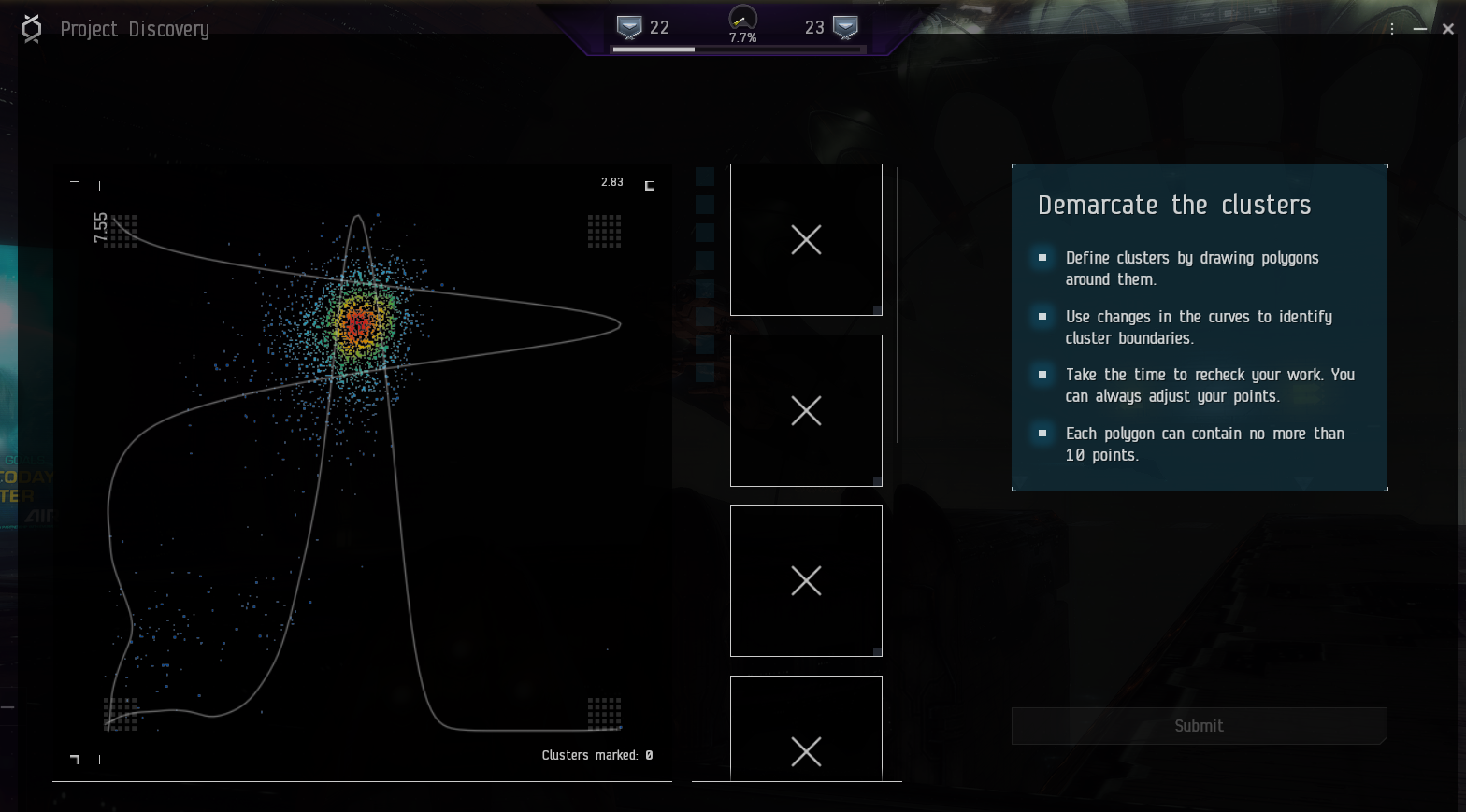
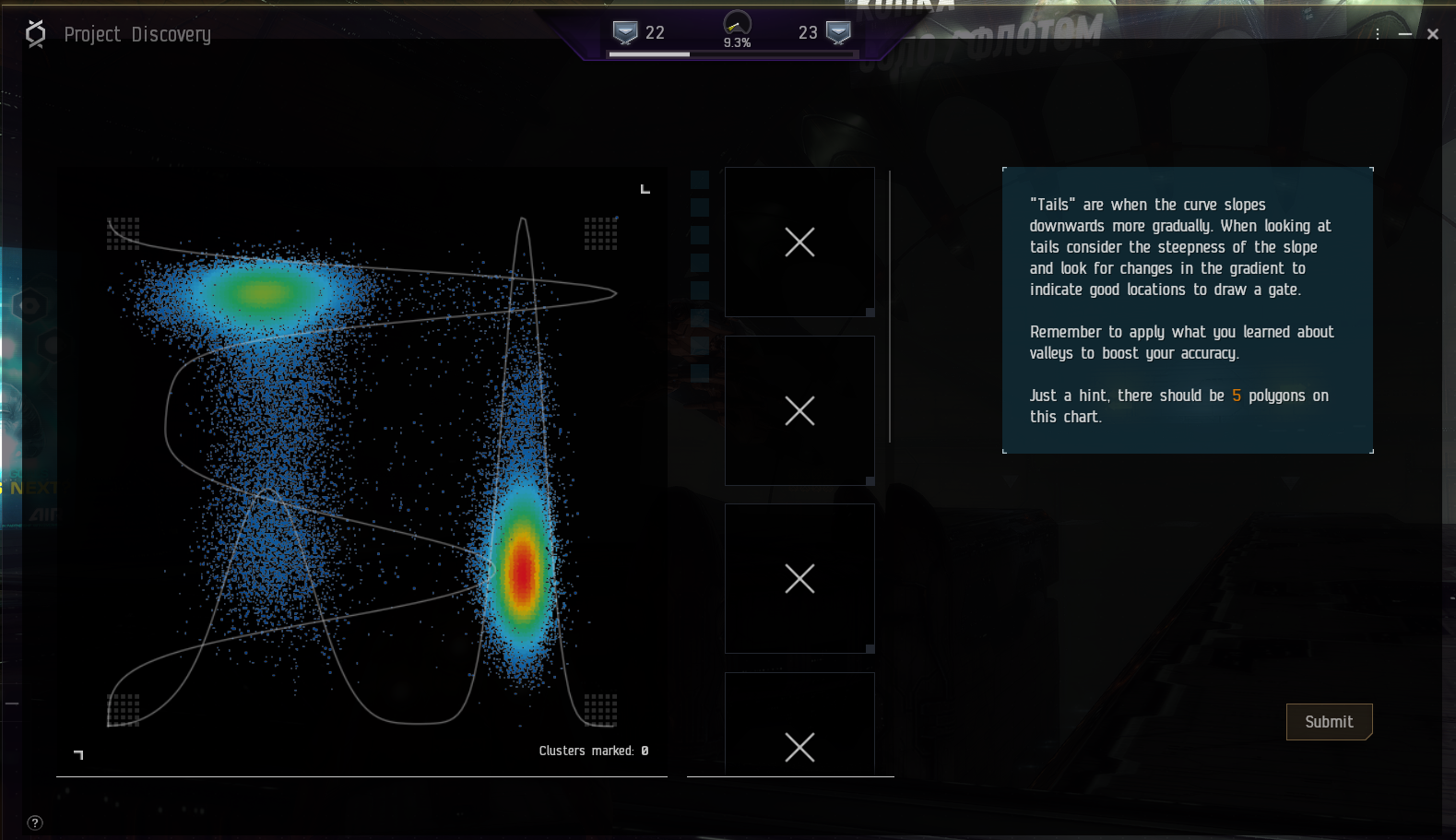
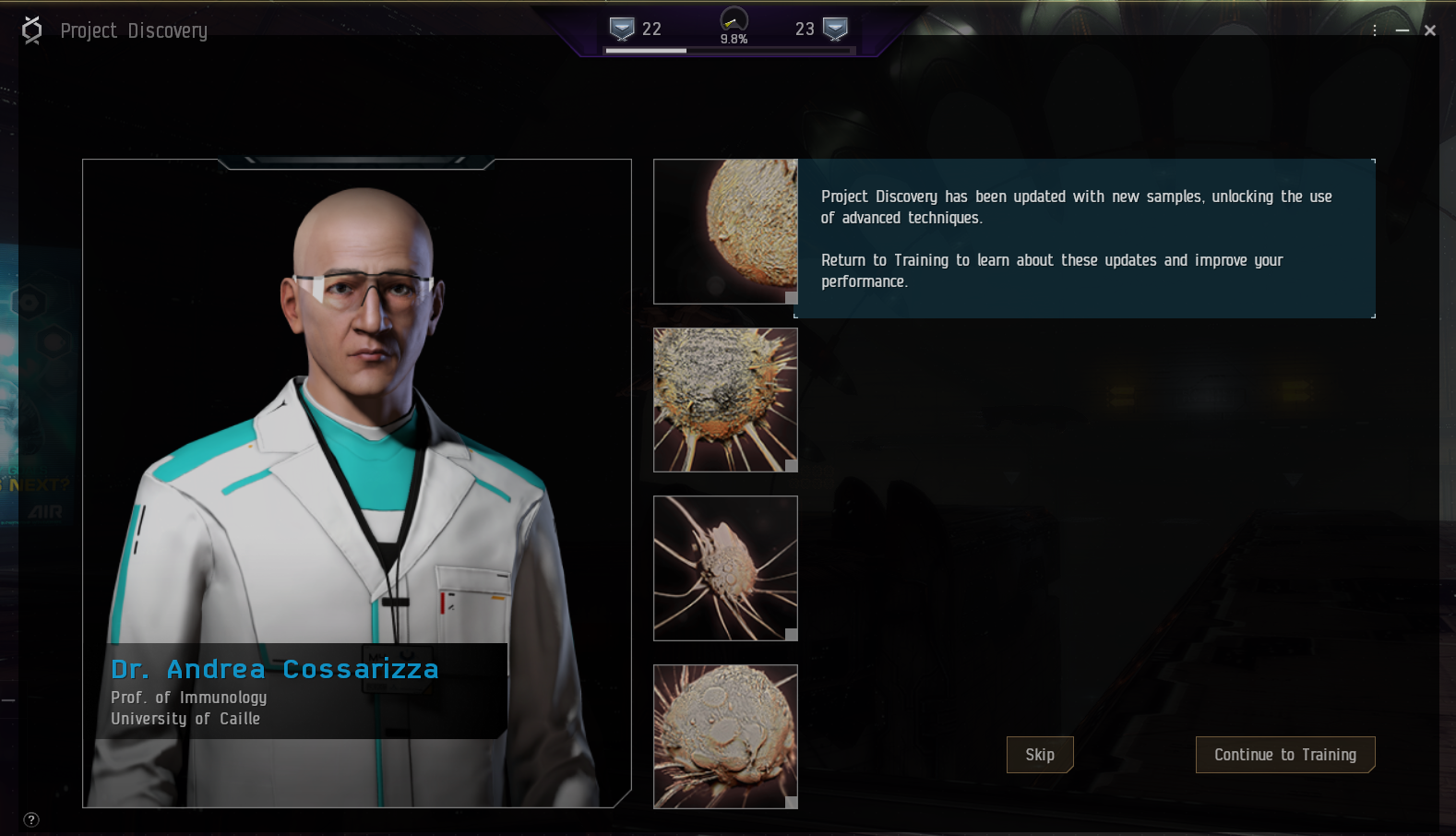
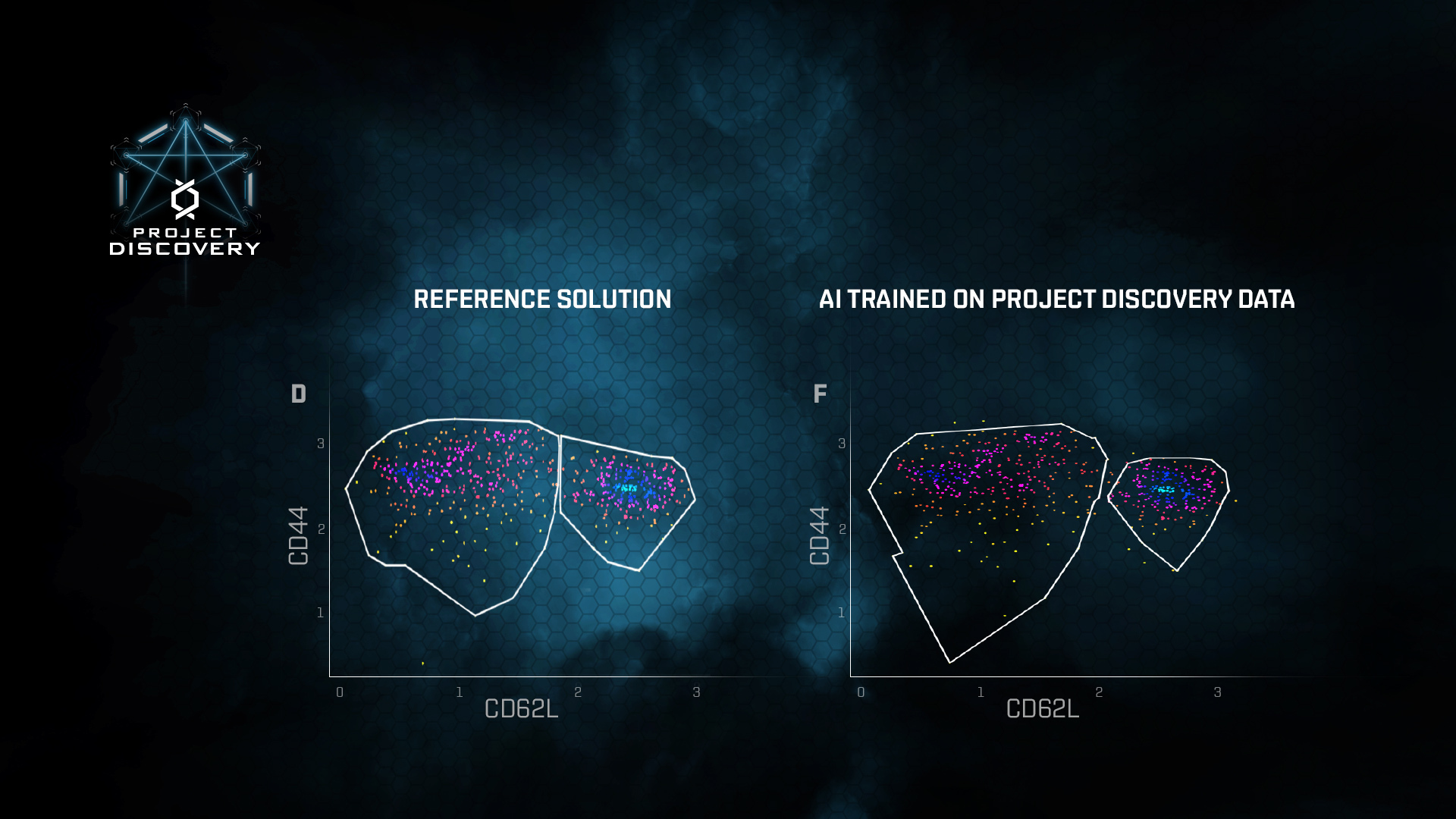
The core loop was still cell-tracing, but Phase Four sharpened the tools. Players could now read complex blood samples through new X/Y axis density curves, drawing polygons around cell clusters in flow-cytometry data with more precision than before. A revised tutorial walked newcomers through the harder task. The point of the added rigour was not busywork: cleaner human boundaries meant better training data, which in turn meant better-performing AI models for decoding how the immune system interacts with cancer. By launch CCP and MMOS reported that two high-performing AI models had already been built from player-generated data across the project's life.
The rewards matched the ambition. Phase Four offered three new SKINR design elements, the Insightful Azure Metallic, Citizen Cyan Metallic and Scientific Panache Satin, alongside the Biosecurity Responders SKIN and exclusive apparel, all earned by contributing to the research rather than bought. Announced alongside the phase at Fanfest 2023 was Play Science, a companion mobile app letting players run Project Discovery from their phones, which entered beta sign-ups in April 2024, and a commitment to release the project's foundational dataset publicly so that outside researchers could develop their own algorithms on top of it.
How it landed
The reception was warm but not uncritical. Veteran EVE blogger The Nosy Gamer gave the phase a hands-on endorsement, pleased that player progress had carried over this time rather than resetting, flagging one real gap, that there was no way to re-enter the tutorial after a long break, and signing off with a blunt "fuck cancer." The sharpest objection was an ethical one. A forum thread argued that gating cosmetic SKINR rewards, which feed PLEX sales, behind cancer-research participation was "a line that shouldn't be crossed," tying charity sentiment to monetisation. The wider community mostly shrugged; replies ran from "I don't get it, what is the complaint?" to a general sense that the science was worth the grind. As one blogger put it ahead of launch, "if science can harness our need for ISK and ship SKINs to help cure cancer, so much the better."
The arc by the numbers
By the time the cancer phase launched, the cumulative record was substantial. CCP put the figures since the 2020 COVID-19 program at over 900,000 EVE Online players participating, more than 500 million citizen-science games played, two high-performing AI models trained on the results, and one Webby People's Voice Award. The Fanfest 2023 reveal had filled in the texture behind those totals: of the data players had examined, almost a third, around 27 percent, met the scientific standard of consensus required for use by experts in flow cytometry and immune-system research, and by 2021 the COVID-19 work alone had contributed over 330 years' worth of research.
What struck the scientists most was that the contribution never tapered off. "Seeing the continuous activity and high-quality contributions of EVE players, we know that Project Discovery is not only a highly valuable tool for science but can also be repurposed to serve many important areas of research," said MMOS CEO Attila Szantner, noting that even four years in, players were still submitting 100 to 200 data analyses every minute. Brinkman, by now describing the result as "a dataset unparalleled in quality and size," argued the timing could not have been better: "In this new era of Artificial Intelligence, this data is pivotal in developing groundbreaking tools for unprecedented scientific discoveries." When his team pitted crowds of capsuleers against professional scientists on the same flow-cytometry plots, the gamers, in aggregate, produced the better answer, an outcome he attributed simply to their numbers.
Eight years of capsuleer science
The clearest proof that the work was real came after Phase Four shipped. In 2025 a team of bioinformaticians published flowMagic, an automated cell-gating tool whose machine-learning model was trained on both expert data and the EVE community's output. The paper credits 839,199 EVE Online players with analysing 52,178 flow-cytometry plots from 37 studies, distilled into 31,703 quality-controlled training plots; the resulting tool hit 90 percent accuracy on common immune-cell populations and outperformed existing methods, and it shipped as open-source software that names the players as its data source outright. What began as an experment in whether a commercial video game could host real research had become a citable line in a flow-cytometry method.
The institutional world noticed too. Project Discovery was recognised by the jury of the 2023 European Union Prize for Citizen Science, which praised it as "a pioneering integration of a citizen-science approach to a Massively Multiplayer Online Game concept" while frankly noting the diversity limits of a hardcore MMO playerbase. Across four datasets and three fields of science, the small Swiss studio that had bet its existence on the idea had put a "fictional" cover on a major scientific journal, earned a Webby, and grown a public dataset that outside labs now build on. Project Discovery remains an optional activity in the EVE client, where a capsuleer can still undock from the war and the markets, open a console, and spend an evening drawing boundaries around human cells that a laboratory will actually use.
Gallery


Sources
- CCP press release - EVE Online launches new phase of citizen science to aid cancer research (2024-07-30)
- CCP press release - Phase Four revealed, expanding to cancer research + companion mobile app (2023-09-22)
- EVE Online - Project Discovery: Phase Four Begins (launch dev blog)
- EVE Online - Project Discovery (initiative site)
- bioRxiv - Citizen science gamers enable automated flow cytometry gating through machine learning (flowMagic, 2025)
- flowMagic - open-source R package trained on EVE Online player data (semontante/flowMagic, GitHub)
- The Scientist - EVE Online Gamers Tackle Flow Cytometry Data in Space
- VentureBeat / GamesBeat - Project Discovery scientists on EVE Online players' contributions (Rachel Kaser)
- Ars Electronica - EVE Online's Project Discovery (European Union Prize for Citizen Science 2023)
- Massively Overpowered - EVE Online ramps up cancer-fighting Project Discovery (Bree Royce, 2024-07-30)
- Shacknews - EVE Online Project Discovery Phase Four + mobile app announced at Fanfest 2023 (TJ Denzer)
- MMOBomb - EVE Online Project Discovery expanding to cancer research (QuintLyn Bowers)
- EVE Online forums - cancer research driving monetization mechanics (launch reception thread)
- The Nosy Gamer - Project Discovery Phase 4: Cancer Edition (2024-07)
- The Ancient Gaming Noob - EVE Fanfest 2023 reactions from the remote view (Wilhelm Arcturus)