·event
Fanfest 2018: two Tranquility server blades go on the charity table
Image: CCP Games
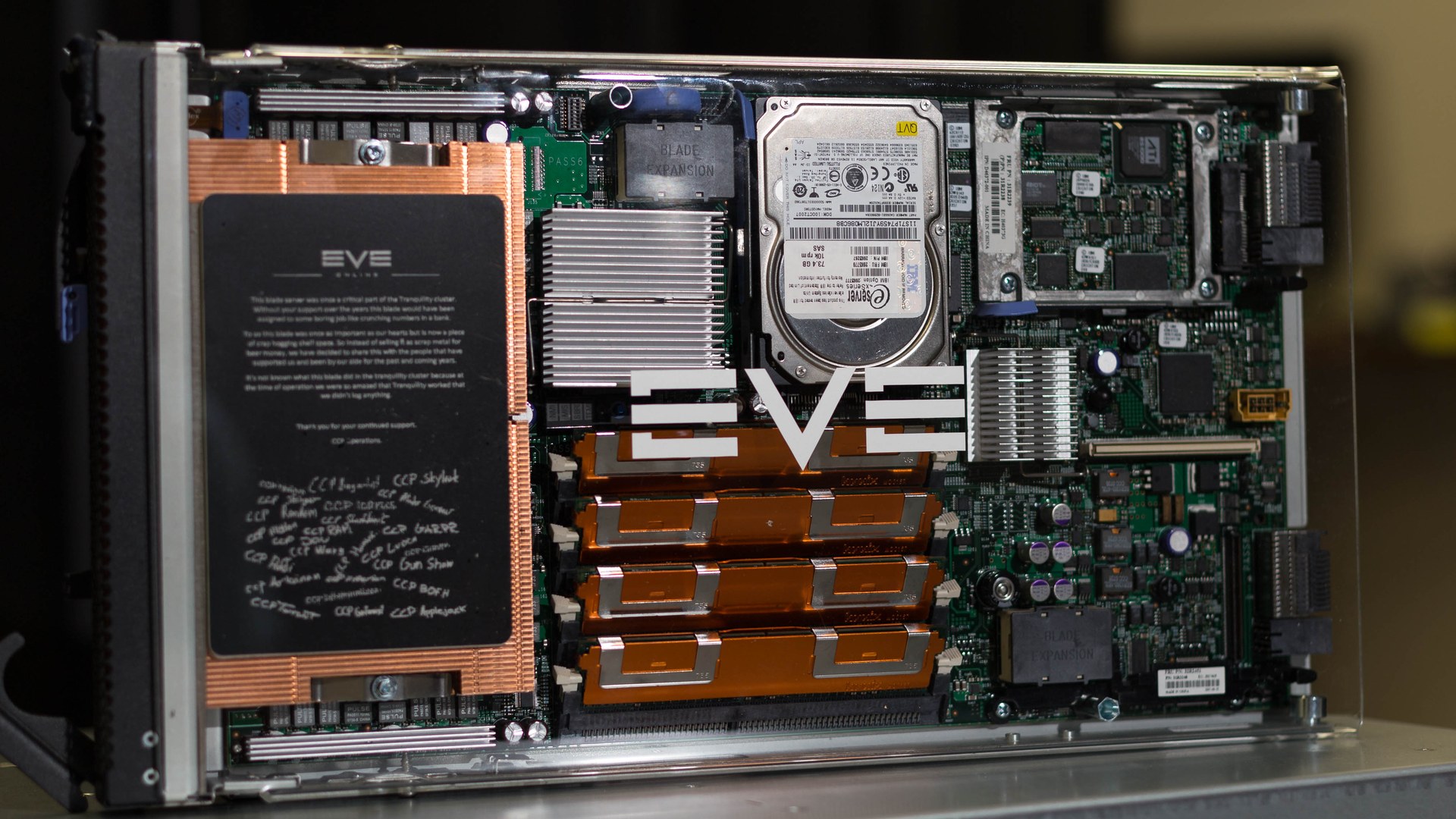
At Fanfest 2018 (12-14 April, Harpa, Reykjavik), CCP put two retired Tranquility server blades into the on-site silent auction - real hardware that ran New Eden from 2006 to 2009, through Revelations to Apocrypha. Proceeds went to the Icelandic Children's Hospital. CCP never published a 2018 outcome, so the winning bids and total raised went unrecorded.
Two real Tranquility blades on a charity table
EVE runs on one server. Not a grid of regional shards but a single cluster called Tranquility, hosted in London, holding the entire game world in one persistent place. As High Scalability's technical breakdown describes it: "EVE Online's Architecture is unusual for a MMOG because it doesn't divide the player load among different servers or shards. Instead, the same cluster handles the entire EVE universe." Players experience it as one server; underneath, it is a rack of individual hardware units, each running a slice of New Eden.
That hardware does not live forever. Every few years CCP upgrades the cluster and a previous generation of blades is decommissioned. At Fanfest 2018 (12-14 April, Harpa Concert Hall, Reykjavik - the convention that marked EVE's 15th anniversary), two of those retired blades were not sent to scrap. They were put on the silent-auction table.
CCP's Fanfest 2018 megablog listed the lot plainly: "This year there'll be a selection of signed and framed concept artwork and expansion keyart up for auction, as well as two Server blades from Tranquility." These were not replicas. According to CCP, the two blades had powered EVE through six expansions: Revelations (November 2006), Revelations II (mid-2007), Trinity (December 2007), Empyrean Age (July 2008), Quantum Rise (November 2008), and Apocrypha (March 2009). Those titles bracket the hardware's working life - it crunched the numbers for New Eden from late 2006 through early 2009, the era when wormholes first opened in Apocrypha, before becoming a relic a player could take home.
What the blades actually were
These were IBM blade servers. CCP ran Tranquility on IBM Blades for most of EVE's history before the 2016 move to IBM FLEX. In cluster terms the workhorses were the SOL blades - High Scalability counts "90 - 100 SOL blades which run 2 nodes each," every node "the primarily CPU intensive EVE server process running on one core." CCP itself called these machines the number-crunching workhorses of New Eden between 2006 and 2009. The blades on the 2018 table came from that compute layer: machines that had hosted solar systems, slices of the market, and character data through the 2006-2009 expansions before the major March 2011 database upgrade and the surrounding hardware turnover retired their generation.
The presentation tradition was already established. When CCP first auctioned retired Tranquility hardware - at Fanfest 2015 - the Operations team had the blades professionally refurbished: each stripped of its steel cover and fitted with a decorative polycarbonate shield exposing the inner workings, and a commemorative plaque fitted over the heatsink. CCP noted the exact engraved text was still being finalized at announcement, but the intent was plain: each blade would carry its service years, the expansions it ran through, and the signatures of the Operations crew, offered to players as a tangible piece of EVE's history rather than scrap.
A four-year-old tradition by 2018
The 2018 lot was not the first. The "own a piece of Tranquility" auction began at Fanfest 2015 with ten refurbished blades, all benefiting Barnaspitali Hringsins, the Icelandic Children's Hospital. Demand was strong enough that CCP brought five more across the Atlantic to EVE Vegas 2015 that same year - because, as the announcement noted, "some of our US players can't make it across the pond for Fanfest." Those ten Fanfest blades, CCP later reported, "sold at auction for very healthy prices, some in excess of $500 US" - the only per-blade figure CCP ever attached a number to.
The pattern then recured year after year: Fanfest 2016 offered five blades plus four retired database CPUs; EVE Vegas 2017 ran its own server-blade silent auction (the megablog paired that event with an AbleGamers charity screening), the format travelling across CCP's conventions on both sides of the Atlantic. By the time the two blades hit the table in 2018, the auction was an established Fanfest fixture.
The Fanfest auction is distinct from EVE's other charity engine. PLEX for Good is the in-game cousin - players donate PLEX, CCP converts it to real money for disaster-relief NGOs like the Red Cross. The Fanfest silent auction is the physical-world version: real artifacts, real-money bids, in the room, with the money going to the Icelandic Children's Hospital. The megablog confirms the destination: "All proceeds from both the Charity Evening and the Fanfest Silent auction will go to the Icelandic Children's Hospital." The paired Charity Evening that year was a $300-a-head, three-course dinner at Harpa's Kolabrautin on the first night, hosted by CCP's leadership, each guest leaving with a certificate signed by the CEO and dev team.
The unrecorded outcome
The megablog is an announcement - it records that the blades went on the table, not what they fetched. CCP published a charity recap for Fanfest 2016 (a grand total "more than $16,100 raised for Barnaspitali Hringsins") and for Fanfest 2017 ("the community has raised USD 13,600"). For Fanfest 2018 there was no equivalent post-event wrap-up. No CCP page, no EVE-press article, and no attendee blog records the winning bids on the two server blades, who won them, or the total raised for the Icelandic Children's Hospital that year.
The outcome went unrecorded. The nearest reference points are the bracketing years - roughly $16k in 2016, roughly $13.6k in 2017 - which point to a comparable four-figure result for the 2018 evening, though that is inference rather than a reported figure.
Still, the core of it is concrete: two machines that ran a virtual galaxy for three years, pulled from the scrap pile, dressed in polycarbonate and signatures, and set on a table in Reykjavik so that someone could take a piece of New Eden's history home while a children's hospital bought equipment with the proceeds. The blades' last expansion before retirement was Apocrypha. The wormholes they spun up in 2009 outlived the hardware that hosted them.
Sources
- The EVE Fanfest 2018 Megablog! | EVE Online
- The Fanfest 2018 15th Anniversary Charity Evening! | EVE Online
- Fanfest 2015 Silent Auction - Servers & T-Shirts & Guns.. Oh My! | EVE Online
- EVE Vegas 2015 - Schedule, Store, Charity Events & More! | EVE Online
- Fanfest 2016 - Cosplay Friday & The Silent Auction | EVE Online
- Fanfest & Birthdays! - New Eden Turns Teenager! | EVE Online
- Fanfest 2017 - Day 3 in review | EVE Online
- The EVE Vegas 2017 Megablog! | EVE Online
- EVE Online Architecture - High Scalability
- Tranquility's Many Upgrades - EVE News24
- Expansions - EVE University Wiki