·event
Project Discovery: Hunting Real Exoplanets
Image: CCP Games · (c) CCP Games (used under CCP fan-content policy)
On 11 July 2017 the second phase of EVE Online's Project Discovery swapped human-cell images for 176,802 real light curves from the CoRoT space telescope, letting players hunt exoplanets under honorary professor Michel Mayor. A rough, too-hard launch settled into 230 million light-curve analyses and a clutch of candidate worlds; Mayor went on to share the 2019 Nobel Prize in Physics.
Project Discovery: Hunting Real Exoplanets
On 11 July 2017, the second phase of Project Discovery swapped a microscope for a telescope. The original minigame had spent a year sorting images of proteins inside human cells for the Human Protein Atlas (see Project Discovery - Citizen Science Inside EVE). The new version handed EVE Online players something stranger: 176,802 real light curves from the CoRoT space telescope, and the job of finding planets in them. It was again a collaboration between CCP Games, the Swiss citizen-science studio MMOS, and Reykjavik University, joined this time by the University of Geneva and honorary professor Michel Mayor.
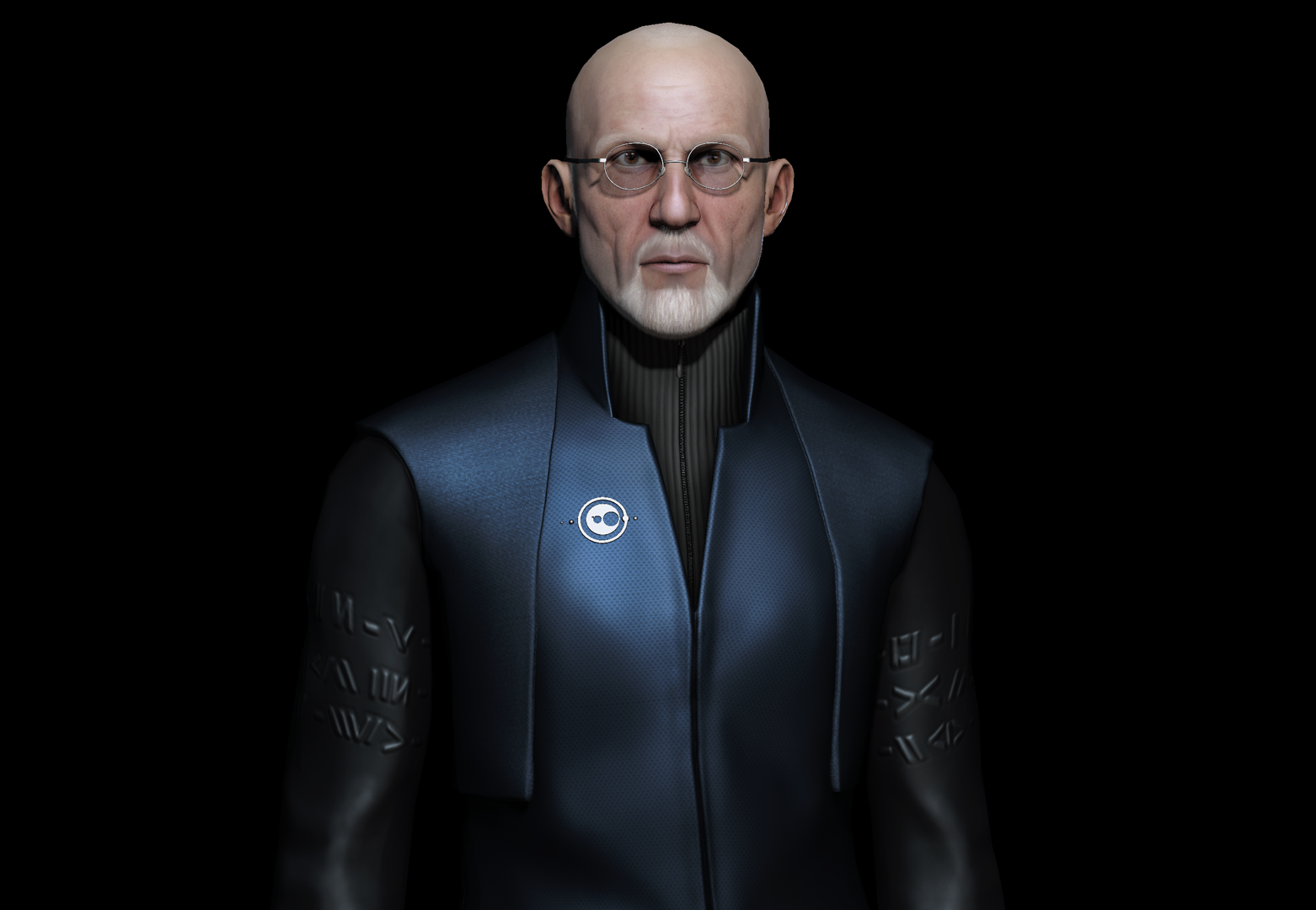
Mayor was not a celebrity guest in the usual sense. In 1995, with Didier Queloz, he had discovered 51 Pegasi b, the first planet ever found orbiting a Sun-like star, and in 2017 he was awarded the Wolf Prize for Physics for it. When CCP announced the phase, Mayor framed his involvement with the kind of line a marketing team could only dream of writing: "I discovered a new world 20 years ago with a telescope and another one this year when I learned about EVE Online and its players at EVE Fanfest." The Rector of the University of Geneva, Yves Fluckiger, put the institutional case more soberly: "The image of the ivory tower is long gone when hundreds of thousands are invited to participate to scientific discoveries."
How it worked
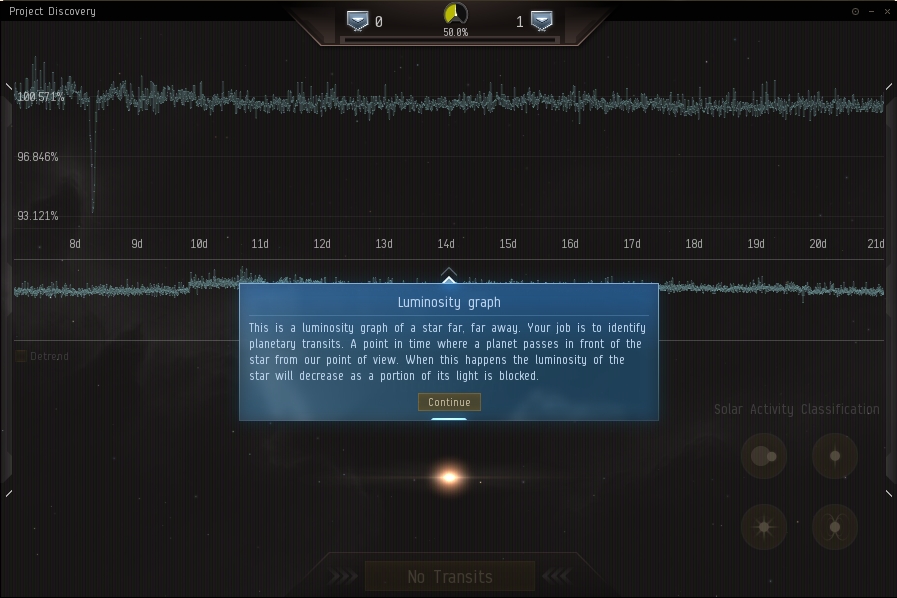
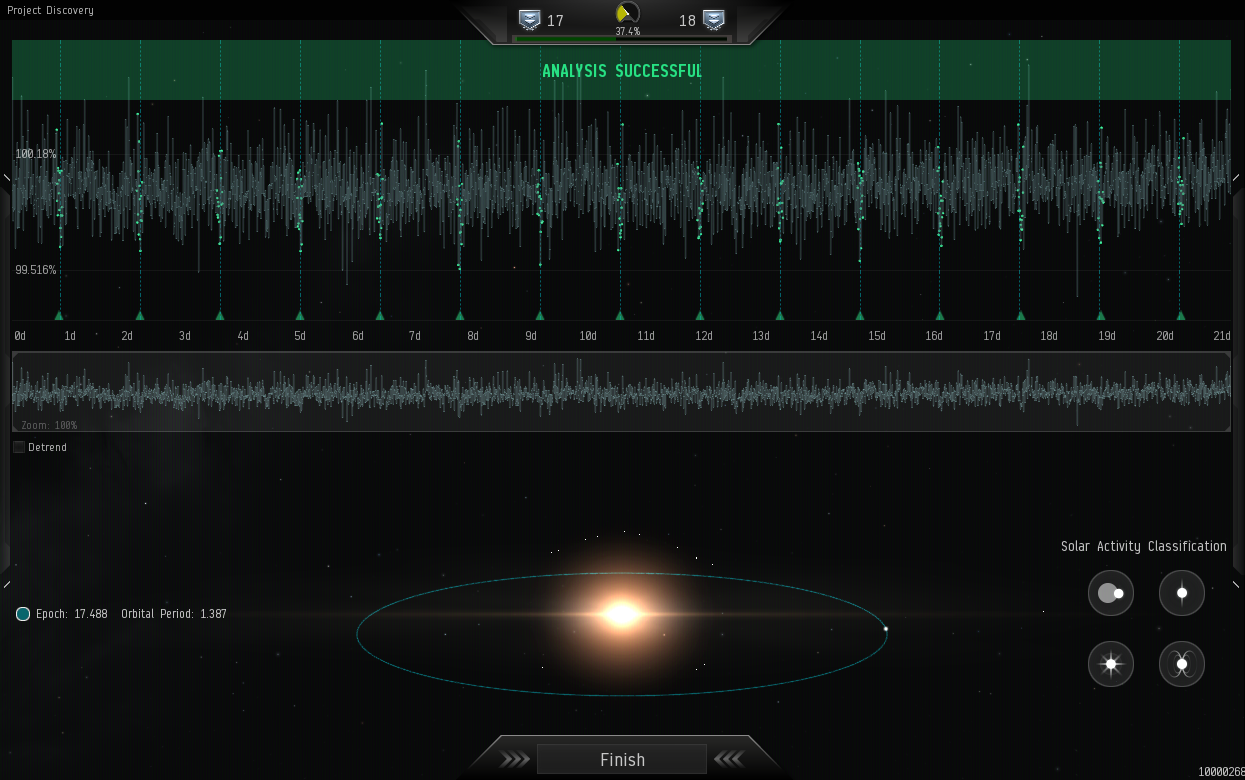
A light curve is just a record of a star's brightness over time. When a planet crosses in front of its star from our line of sight, it blocks a sliver of that light, and the curve dips. This transit method is how most known exoplanets have been found, including the seven worlds of TRAPPIST-1. CoRoT, a French-led space telescope launched in late 2006, had already produced 37 confirmed exoplanets this way before its data ever reached New Eden. The catch is that real transits are buried in noise: stellar flicker, instrument artefacts, and eclipsing binary stars all forge dips that look like planets. Computers are good at the obvious cases and bad at the ambiguous ones, which is precisely where a large pool of human pattern-matchers earns its keep.
Players marked candidate transits inside the in-client minigame, and a consensus across many submissions was passed to the MMOS platform and on to Geneva for vetting. The reward structure was tuned to keep capsuleers coming back: PLEX, exclusive SKINs, and blueprints for prestigious CONCORD ships, with the better payouts gated behind accuracy rather than raw volume. A player could do nothing but classify light curves from the safety of a station, on a free account, and never undock into the dangerous parts of the game at all.
A rough launch
The phase did not arrive smoothly. The exoplanet data was simply harder than the protein images had been, and the tutorial difficulty curve had been calibrated for the older, easier task. At launch, new players got funnelled into a training loop they could not escape: the system kept serving them the hardest sample tier, they kept failing it, and their accuracy ratings cratered. The friction had even been visible on the Singularity test server weeks earlier, where one tester warned that "some of the transition events are very subtle and I'm having trouble determining what they look like" and asked for worked examples. It shipped anyway.
The community reaction was blunt. On the official forums, one capsuleer called the real-data samples "un-playable and the user-interface sucks" after hours of finding nothing; another declared the whole thing "broken" and reported better results just clicking the No Transition button on every sample thsn actually trying. CCP and MMOS acknowledged the problem inside the client, conceding that the "data sets that are presented for analysis are too difficult for that stage," and pushed a fix after the 12 July downtime: the hardest tier was removed from the training period, and every player whose accuracy had fallen below 50 percent had it reset back to 50. Players filled the remaining gap themselves, with community broadcasters and pilots like Eyon Vondawn of Spaceships Involved recording tutorials on how to read the new samples.
What the players found
The numbers recovered quickly. By the time Geneva published a first look in January 2018, EVE players had delivered 44.4 million classifications from 77,709 participants in 190 days, a pace the team compared favourably to Zooniverse's Galaxy Zoo, which had taken its first year to reach 50 million. Mayor's astronomers reported that "hundreds of light curves, previously thought to have no transits, have been identified by the pilots of EVE Online as new transit candidates with a very high consensus," while carefully noting that a high consensus is not the same as a planet. Most flagged dips would turn out to be artefacts or binaries. Even so, the team wrote, "the pilots of EVE Online have shown themselves to be effective, real-life explorers of the galaxy."
Two years in, the contribution was larger and the verdict more honest. By mid-2019 the Geneva Observatory had received some 230 million light-curve analyses, with PlanetS researcher Francois Bouchy in charge of the player data. The strongest results were two mono-transit candidates, a possible Saturn-like world on a minimum 71-day orbit and a possible Neptune-like one near 91 days, both too weak to call discoveries and both queued for follow-up on the 1.2-metre Swiss Euler telescope at La Silla in Chile. The player effort also surfaced something the professionals had missed entirely: a bug in the public CoRoT dataset, where "eclipsing binaries were unfortunately used to correct the satellite's jitter and accidentally introduced false transits that were revealed by the players." No confirmed, named exoplanet was ever credited to EVE Online. The legacy is a pile of high-quality candidates, a cleaned dataset, and a proof that the method works.
From the Fanfest stage to the Nobel podium
Mayor had introduced the phase in person at EVE Fanfest 2017 in Reykjavik (see Fanfest 2017 - Project Discovery Goes Hunting Exoplanets), standing on stage in front of a hall of capsuleers to explain the science of the search. Two years later, on 8 October 2019, he and Didier Queloz were awarded half of the Nobel Prize in Physics "for the discovery of an exoplanet orbiting a solar-type star," the same 51 Pegasi b work that had qualified him to lead the EVE collaboration. CCP's own retrospective now reaches back and quietly relabels him a Nobel Laureate. It is a rare thing for a video game's promotional partnership to age into a Nobel footnote.
The exoplanet phase ran in EVE's calendar until 15 June 2020, when it gave way to a third phase that pointed players at COVID-19 immune-cell data, and the work was later memorialised by an in-game monument in the Pakhshi system. The press had reached for the obvious framing at launch and, for once, more or less earned it. Engadget called the whole arrangement "the stuff science fiction, and soon science fact, is made of," and a launch-day write-up at Alphr closed on the thought that "maybe the next truly habitable New Earth will be found by an EVE Online player." It has not happened yet. The point of Project Discovery was always that it could.
Gallery
Sources
- CCP press release - EVE Online joins search for real exoplanets with Project Discovery (2017-07-12)
- CCP dev blog - Encouraging Signals: a Project Discovery update (preliminary results, January 2018)
- CCP dev blog - Project Discovery tutorial video and AMA on r/science (2017-09-20)
- NCCR PlanetS / University of Geneva - Discover exoplanets while playing (Barbara Vonarburg, 24 June 2019)
- The Nobel Prize in Physics 2019 - Michel Mayor and Didier Queloz
- EVE University Wiki - Project Discovery: Exoplanets
- Imperium News - Summer update roll goes smoothly, Project Discovery tweaked (Arrendis, July 2017)
- EVE Online forums (eve-search.com mirror) - Tips for Project Discovery exoplanets
- Engadget - EVE Online wants you to discover real exoplanets (Stefanie Fogel, 22 February 2017)
- Alphr - EVE Online players are helping astronomers search for real-world exoplanets (Vaughn Highfield, 11 July 2017)
- EVE Travel - Project Discovery Phase Two Monument (Mark726, 11 April 2021)