·expansion MAJOR
Aegis - Entosis Link Sovereignty
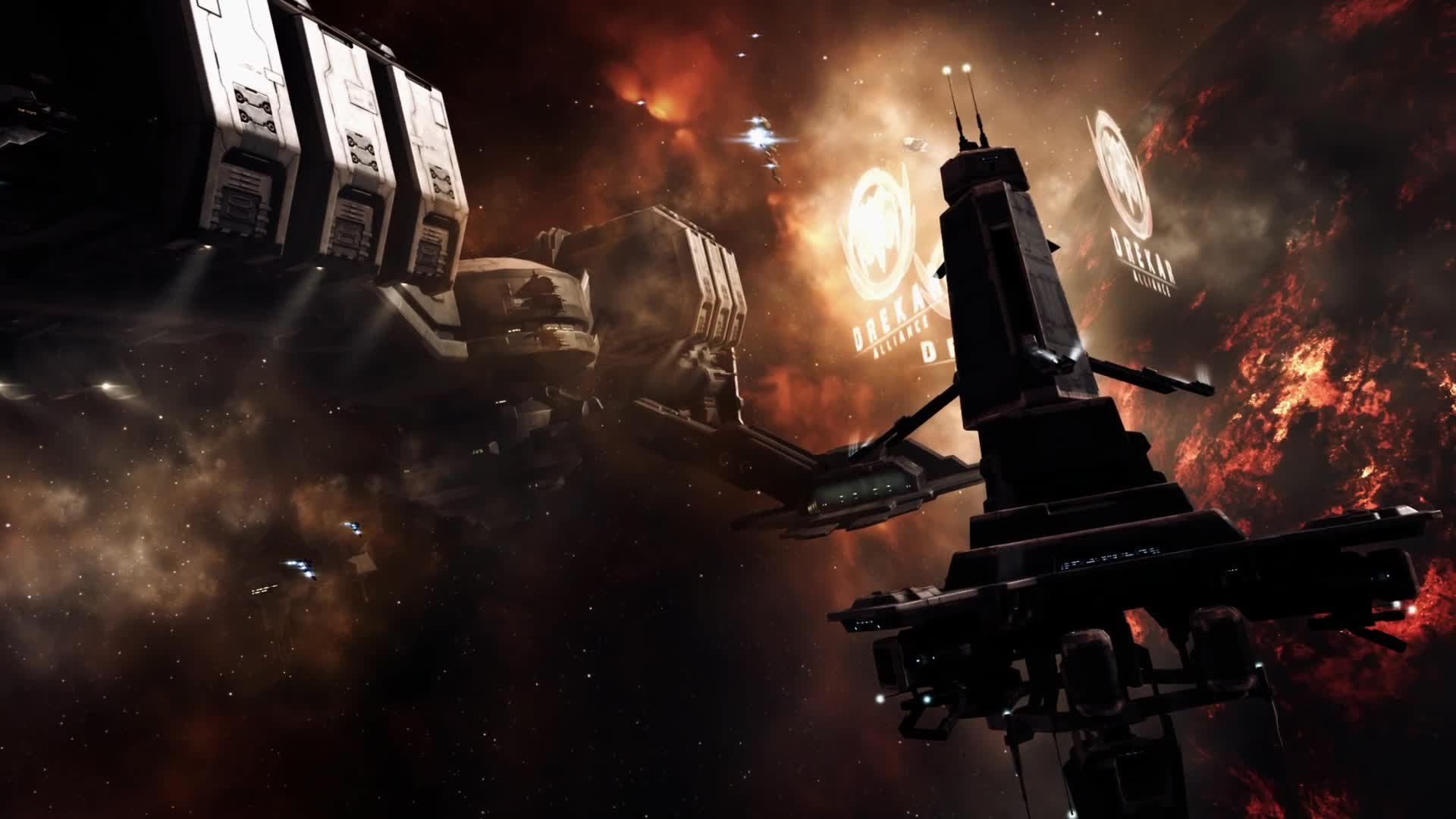
Image: CCP Games · Fan-content policy: https://www.eveonline.com/news/view/eve-online-fan-content-policy
TCU and SBU mechanics were replaced by Entosis Link captures with attacker-chosen vulnerability windows and rolling defence. Sov warfare became smaller-scale and more disruptive.
Aegis - what changed
Background
EVE Online: Aegis shipped on 14 July 2015 and is the patch that ended Dominion-era sovereignty. The Entosis Link replaced weapons fire as the only mechanism to attack sov structures; the Activity Defense Multiplier tied defender resilience to actual system use; Sovereignty Blockade Units became obsolete; Command Nodes turned a single-structure grind into a constellation-wide tug-of-war.
Together the changes are known as Fozzie sov, named for lead designer CCP Fozzie. The Entosis Link mechanic itself was introduced earlier in Carnyx (2 June 2015), with Aegis being the completion of the rework - some retrospectives credit Carnyx with the rework and treat Aegis as the sov-only patch.
What changed, by playstyle
PvP
Aegis is Fozzie sov - the sovereignty mechanic named for CCP Fozzie that replaced the Dominion-era "grind structure HP" model with the Entosis-Link-driven Command Node capture system. If you held nullsec in 2013, the change is foundational: you cannot grind a station to take it any more. You drop an Entosis Link, capture nodes around the constellation, and the Activity Defense Multiplier of the system you're attacking dictates how long the timer is. The defender-side ADM math means sov you actively use defends harder than sov you just sit on; the attacker side has to spread effort across a constellation, not concentrate it on one structure. The whole "weekend sov-grind" subgenre died on 14 July 2015 and has not come back.
Social / political
The political knock-on from Aegis was almost as big as Phoebe's. Smaller alliances could try to take sov for the first time in years; the question wasn't "do you have 100 dreads" but "can you sustain entosis runners in a constellation for the duration of a tug-of-war." Time-zone-tanking became real - alliances picked vulnerability windows in their dominant TZ and recruited accordingly, which is why "AUTZ alliance" or "NA-prime" started showing up in alliance recruitment ads in 2015. The renter-empire economic model softened: unused renter space became harder to defend than used space, which pushed landlord alliances toward different renter-ratio decisions. These are second-order effects but they shaped the entire 2015-2016 nullsec-political map and the run-up to the Casino War.
Aftermath / what stuck
The Casino War ten months later was fought partly on Aegis-rules, with MBC's Money-Badger Coalition exploiting the new constellation-tug-of-war mechanic against The Imperium. If you came back to EVE after walking away pre-2015, the entire mechanical primitive of how nullsec sov works is different, and the older guides on dominion-era sov-grinding describe a game that no longer exists. Aegis sov persisted as the canonical sov mechanic for nine years, until Equinox (June 2024) replaced it with Sovereignty Hubs and Skyhooks.
What changed for you
compare across expansions ->Top picks · highest impact across all playstyles
-
5
PvP
Sovereignty capture moved from grinding structure HP to capturing Command Nodes via Entosis Link - the new module replaces weapons fire as the only way to claim a sov structure, turning a "who has more dreads" question into a "who controls more constellation-wide capture nodes" question.
-
5
PvP
The Activity Defense Multiplier (ADM) was introduced - defender-side bonus that increases capture timer length based on the system's Strategic, Military, and Industrial development indexes, meaning systems you actually use defend longer than systems you just hold on a map.
-
4
Social
Sov-grinding teams shrank - pre-Aegis you needed a capital fleet to break a structure, post-Aegis you need a coordinated entosis-runner squad of frigates / interceptors plus reaction-force support, lowering the barrier to even attempt a sov flip.
All changes by playstyle (9 changes across 2 playstyles)
-
5
Sovereignty capture moved from grinding structure HP to capturing Command Nodes via Entosis Link - the new module replaces weapons fire as the only way to claim a sov structure, turning a "who has more dreads" question into a "who controls more constellation-wide capture nodes" question.
caveat
Entosis Link mechanic itself shipped earlier in Carnyx (2 June 2015); Aegis (14 July 2015) is the completion of the Fozzie sov rework. Some retrospectives credit Carnyx with the rework.
-
5
The Activity Defense Multiplier (ADM) was introduced - defender-side bonus that increases capture timer length based on the system's Strategic, Military, and Industrial development indexes, meaning systems you actually use defend longer than systems you just hold on a map.
-
4
Sovereignty Blockade Units (SBUs) became obsolete - the old "put down a SBU to start a sov fight" mechanic was retired, replaced by Entosis-Link-driven attacks that can be initiated without prior staging; existing SBUs auto-destructed on patch day.
-
3
Default Vulnerability Time per system became a configurable defender choice - alliances pick a 4-hour vulnerability window per day rather than the old "always vulnerable in EU prime" arrangement, with 48 hours to take effect after change.
-
3
Capture timers stopped being a single grind and became a constellation-wide tug-of-war - five Command Nodes spawn across the constellation at random within 24-72 hours of attack initiation, each captured node adds 5% progress, defenders win at 100% and attackers win at -100%.
-
4
Sov-grinding teams shrank - pre-Aegis you needed a capital fleet to break a structure, post-Aegis you need a coordinated entosis-runner squad of frigates / interceptors plus reaction-force support, lowering the barrier to even attempt a sov flip.
-
4
Time-zone-tanking became a defender strategy - the per-system 4-hour vulnerability window meant alliances picked windows in their own prime time, and Aegis-era "AUTZ-tanking" or "NA-tanking" became standard alliance-recruitment language.
-
3
Renter-empire economics shifted - the "rent space, never use it, never lose it" arrangement got harder, since unused space accumulates lower ADM and defends less; landlord alliances had to push renters toward actually using the space they paid for, or trim their renter footprints.
-
2
TCUs / IHUBs / outposts became individually attackable - you could now flip a station's services without flipping the IHUB or the TCU, splitting what used to be a single sov-flip event into multiple separable contests; created a new tier of "partial occupation" political states.
Impact score 1-5 (5 = paradigm shift for that playstyle).
Sov context at this date
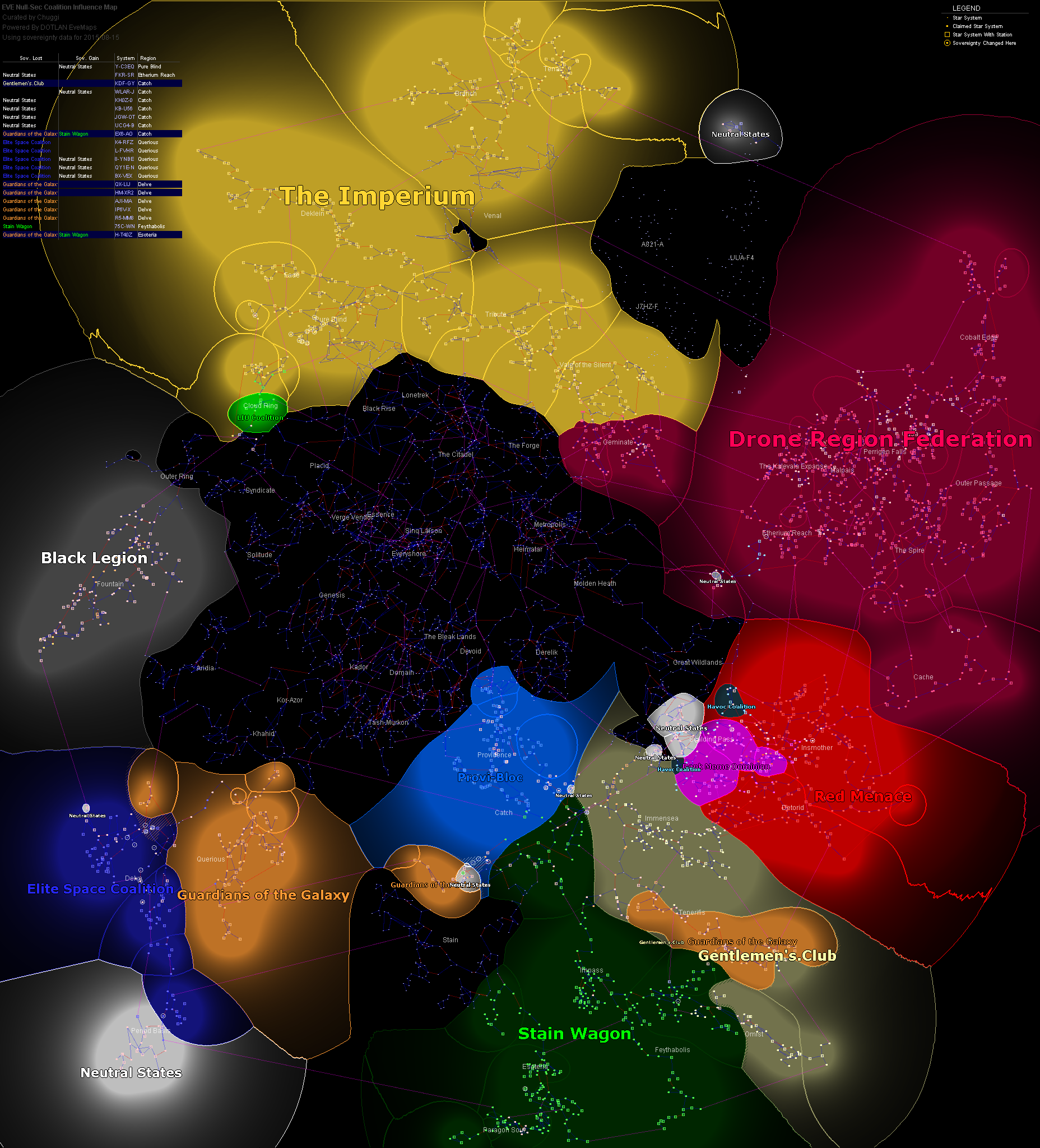
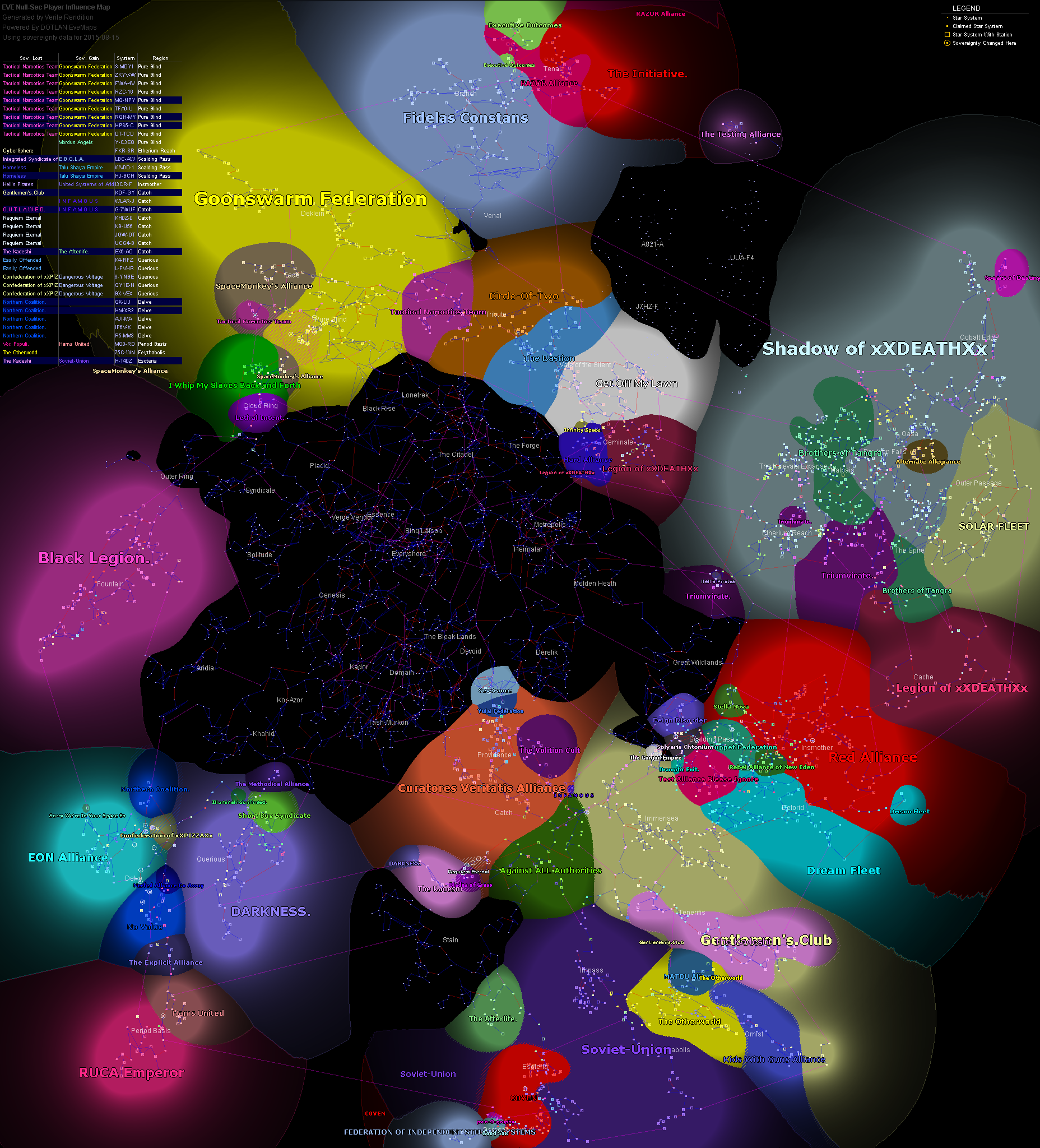
Maps mirrored from verite.space (Verite Rendition).
Sources
- EVE Online - Patch notes for Aegis Sovereignty
- EVE Online - Aegis Sovereignty deployment July 14
- EVE University - Entosis Link
- EVE University - Sovereignty
- CCP patch notes
- CCP devblog - Summer 2015 Nullsec and Sov Status Report
- Massively OP - Aegis sov retrospective
- TAGN - Aegis-era nullsec coverage
- EVEoganda - The Power of Entosis (cultural color, March 2015 pre-launch)