·event MAJOR
CCP Games Becomes Fenris Creations
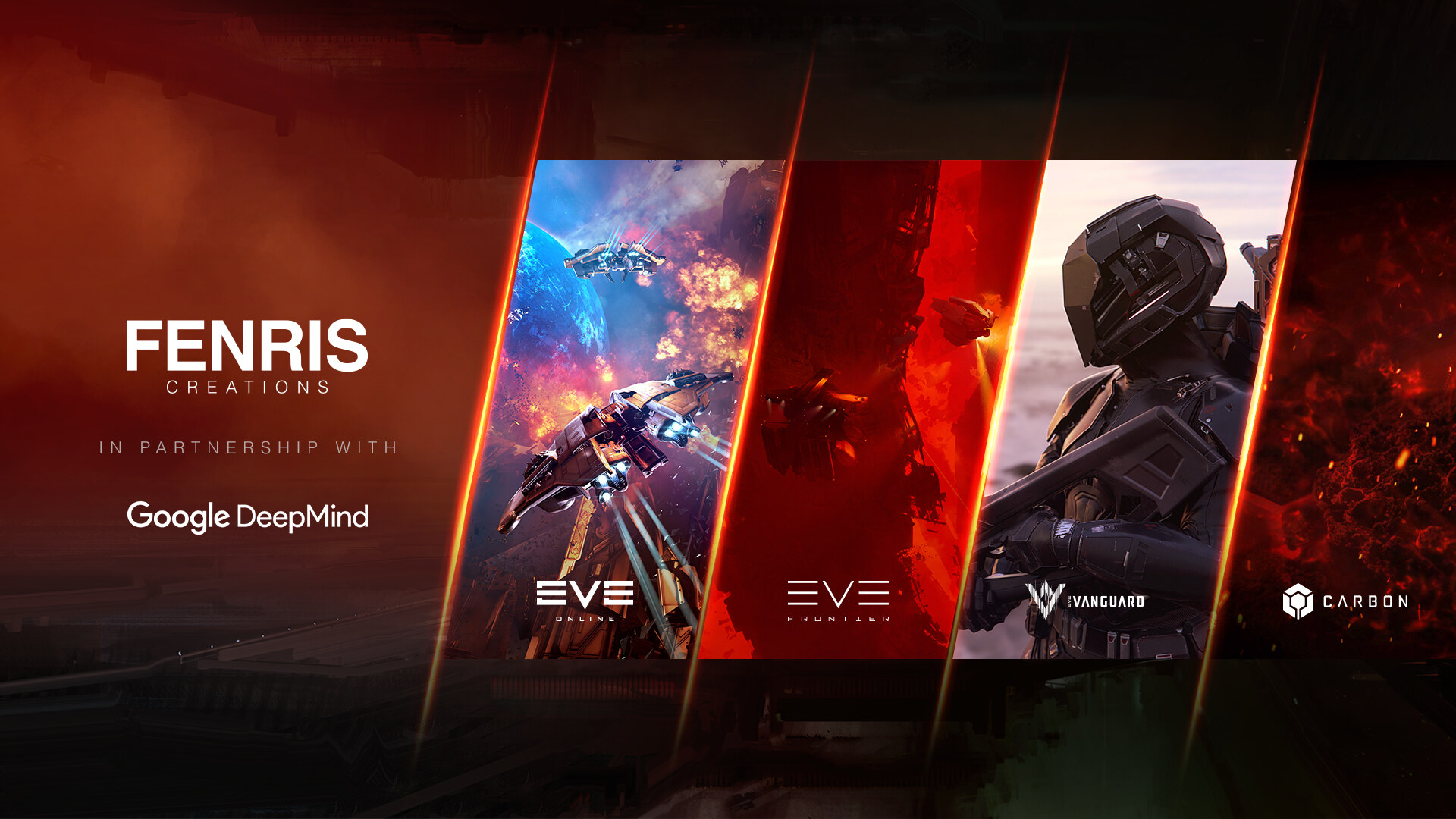
Image: Fenris Creations (CCP Games) · Fenris Creations IP; rebrand announcement key art (fan-content policy)
On 6 May 2026, EVE Online's 23rd anniversary, the studio known as CCP Games for nearly three decades rebranded as Fenris Creations and became independent again, having bought itself back from Pearl Abyss. CEO Hilmar Veigar Petursson cited the brand collision with the Chinese Communist Party as the reason to drop "CCP." The same announcement opened a research partnership with Google DeepMind that will use an offline copy of EVE as an AI testbed, with Google taking an undisclosed minority stake.
CCP Games Becomes Fenris Creations
On 6 May 2026 - EVE Online's twenty-third anniversary to the day - the studio that had built and run New Eden as CCP Games for nearly thirty years announced that it was changing its name to Fenris Creations and becoming an independent company again. The same post opened a research partnership with Google DeepMind. For a corporate event, it was unusually loaded with meaning, and yet, as the studio itself was at pains to say, almost nothing about the game you log into changed.
A studio renames itself
The announcement came in a post titled "A New Era," written by CEO Hilmar Veigar Petursson and published on the EVE website on the morning of 6 May. The legal substance was a rename and a change of ownership: the company would operate under the new name Fenris Creations, owned by its shareholders and governed by its own Board of Directors. The official press release that went out the same day put it in corporate terms - the ownership group comprised the studio's senior management and long-term investors, and the new structure returned the company to "a model similar to how the company operated before 2018." This was the studio becoming independent again, the second time in its history, after the 1997-to-2018 stretch of independence and the eight Pearl Abyss years that followed. The independence completed the Pearl Abyss management buyout that had been announced a week earlier; the buy-back itself, a roughly $120M transaction, is that card's story to tell.
What changed corporately was almost everything; what changed for players was almost nothing, and the post said so directly. The teams building EVE Online, EVE Frontier, EVE Vanguard, and EVE Galaxy Conquest stayed in place. The studios in Reykjavik, London, and Shanghai continued exactly as they were. Leadership, creative direction, products, and development plans were unchanged, Hilmar stayed CEO, and the transition involved no restructuring and no layoffs. The visible change for a capsuleer was a new name in the launcher and a new trademark line in the website footer, where the copyright now read Fenris Creations. The substantive change was who owned the studio and who sat on its board. Hilmar signed the post not as himself but as a fleet commander would sign a broadcast:
FC Hellmar
Why drop "CCP"
The first question the announcement raised was why a studio would walk away from a brand it had carried for almost twenty-nine years. CCP stood for Crowd Control Productions, the name the company was founded under in 1997. In a follow-up interview with GamesIndustry.biz two days later, Hilmar gave the reason without hedging: the acronym had collided with the most loaded three letters in geopolitics.
It is an interesting journey of the brand collision between Crowd Control Protections and the Chinese Communist Party. That is a growing collision. It's a fight I'm not going to fight. I'm not going to fight the Chinese Communist Party over who is the CCP.
(The transcript renders the company name as "Crowd Control Protections"; the studio's actual founding name was Crowd Control Productions.) The collision was not abstract. Hilmar described reporters writing stories in which the studio was "literally referred to as the other CCP," and CCP employees being questioned at the US border over the name. None of it was catastrophic on its own, but the direction of travel was clear, and the studio was already making a wholesale change of ownership and identity in the same week. As Hilmar framed the timing: "These are not big things, but I can sense where this is going. We were already making all these changes. It's a good time to do it; if we don't do it now, will we ever?"
Where "Fenris" comes from
The new name reached back to two places at once: Norse myth and the studio's own founding. In Norse mythology Fenris, or Fenrir, is the monstrous wolf bound by the gods and fated to break loose and devour Odin at Ragnarok, the end of the world. Hilmar described the choice as "a reference to destruction and creation and how they are intertwined, how death is a serious matter in EVE Online," calling it the Viking way of talking about entropy. That phrase - death is a serious matter - is the oldest idea in the company. The "A New Era" post traced it back to the founding belief of 1997: that for a virtual world to have meaning, it must be shaped by risk, loss, renewal, and the people who inhabit it. It is the same conviction that makes a destroyed ship in EVE actually gone, and it is the conviction that "EVE Forever," the studio's long-horizon slogan, is built on.
The name was also literally on a box once. The studio's earliest published game carried the Fenris name; in the GamesIndustry interview Hilmar dated it to a 1998 board game, Haettuspil, or Danger Game, published under the Fenris label. Nearly three decades later the studio took that first idea and made it the name over the door, a reminder of the kind of worlds it set out to build.
The Google DeepMind partnership
Bundled into the same announcement was the genuinely new thing: a research partnership with Google DeepMind. The scope, as the press release framed it, was the study of intelligence in complex, dynamic, player-driven systems - specifically long-horizon planning, memory, and continual learning, the open problems where an environment that behaves like a living world is more useful than a board game. DeepMind would run the research against an offline copy of EVE Online on a local server, to test and evaluate models in a controlled setting, and the two companies would also explore new gameplay experiences the technology might enable. Hilmar placed it in the lineage of DeepMind's earlier game-playing milestones, AlphaGo and AlphaStar, and asked the rhetorical question the partnership rests on: if you follow that line of harder and harder games, what is the ultimate game? His answer was EVE Online.
The player-facing post carried the partner's own voice. Alexandre Moufarek, a Director at Google DeepMind, supplied the on-the-record quote:
As a gamer and games producer, I've long admired EVE. What the EVE community has created together with Hilmar and team is truly unparalleled in gaming. It is a one-of-a-kind simulation for testing general-purpose artificial intelligence in a safe sandbox environment.
(The press release carried a parallel quote from Demis Hassabis, DeepMind's co-founder and CEO, calling EVE "a player-driven universe as amazingly complex" as any.) Adrian Bolton, part of DeepMind's founding team, was named as the guest who would join Hilmar on the Fanfest stage the following week to say more. Google also took a minority stake in the studio as part of the transition. The exact size was not disclosed; neither the announcement, the press release, nor the Fanfest fireside chat that followed named a figure, and the widely circulated community estimate of roughly a 20% stake worth about $24M was derived from the buy-back valuation rather than disclosed by the companies.
The honest caveat came from the studio itself, and the body of this archive repeats it because it matters: to be very clear, the initial research would take place in controlled, offline versions of EVE that are not connected to Tranquility, the live server. It opened a door, in Hilmar's words, to work that felt true to EVE - difficult problems, long timelines, strange possibilities - but it did not point the live game's data at an AI on day one.
One piece was already live, and far less exotic than a sandboxed AI: Google's Gemini had quietly been helping power EVE's new-player guidance, and at the fireside Bolton described leaning on the Gemini app to find his own footing in the game, recovering a lost mission item and picking a cheaper module off the marketplace.
Community reaction
The community response was the EVE community being itself: a layer of jokes over a real argument. The first joke wrote itself, because to a fleet commander the initials "FC" mean exactly one thing, and the studio's community managers leaned all the way into it. On the meme thread that sprang up within hours, a player addressed the freshly renamed studio as a fleet boss and asked the eternal fleet question - "fcplease can I bring my drake :)" - and CCP_Swift answered in the only correct register, with the call an FC gives to send a fleet through a gate:
The gate is green
The second joke was about the oldest unfixed in-joke in the game. The top comment under the official announcement turned the AI partnership into a wish:
Perhaps Google deepmind will be able to locate the pos code
Beneath the jokes ran a genuine debate about whether the move was shrewd or embarrassing. The skeptics filed it under CCP chasing yet another buzzword too late. The Pandemic Legion pilot u/avree laid out the case as a pattern: "PS3 Games before PS4 came out, Blockchain Games after all blockchain hype has died, VR games after VR hype has died," and now AI. The contrarian read came from the editorial that drew the most attention, by u/Ohh_Yeah, whose headline inverted the whole framing - "This is not CCP chasing a trend. It is, for once, CCP cashing in on one" - and argued that getting a major AI lab to pay for a minority stake and run experiments on a sandboxed copy was, unironically, "probably the best deal that CCP has ever made." Running underneath both was a quieter worry about an AI lab anywhere near a beloved game's data, which the offline-server caveat was aimed squarely at; and running underneath everything was a thread of pure defiance, the players who shrugged and said they would go on calling the studio CCP no matter what the launcher said.
The joke got a straight answer a week later. At the Fanfest fireside an audience member asked whether the partnership could help repair the game's spaghetti code, and Hilmar said it was already happening: AI coding agents had been turned loose on a codebase written across thirty years, where the original context was often long gone, and were surfacing real memory and security issues for the human developers to fix. The community's standing joke about the POS code had, more or less, come true.
What it means
Strip away the jokes and the press copy and what 6 May 2026 amounts to is an identity change with near-zero immediate gameplay impact stacked on top of a real strategic pivot. Nothing in the game shifted that day; your characters, your assets, your wars, and the people building them were untouched. But the studio came out of the week independent of Pearl Abyss for the first time in eight years, governed by its own board, and openly betting that a sandboxed copy of its own universe was a good place to do frontier AI research.
CCP described the company as profitable with strong reserves, and the EVE Online numbers behind that were genuinely good: a record-breaking November and revenue on the order of $60 to $65M for the year, strong for a game past its twentieth birthday. The fuller picture, as the EVE-economy analyst OZ_Eve read it out of the filed accounts, was harder. The studio as a whole posted a net loss of about $28.8M for 2025, widening from roughly $19.4M the year before, because EVE Online's revenue was being outspent by heavy investment in EVE Frontier, EVE Vanguard, and blockchain development that was not yet earning anything back. That spending leaned on debt and deferred revenue - a $50M loan from Pearl Abyss, plus tokens issued against future earnings - leaving the newly independent studio with a sharp bet to make: EVE Frontier has to succeed for the company to return to profit, or the debt has to be dealt with another way.
The rename is the visible part; the independence and the DeepMind bet are the substance, and both sit on top of the buy-back the Pearl Abyss management buyout card covers. The undisclosed pieces, chiefly the size of Google's stake, stayed undisclosed, and the only honest thing to say about the AI research is the studio's own line: it runs offline, away from Tranquility, for now. The trabsition closed where these things usually open, at Fanfest, where the studio promised to say more about both the games and the research; that week is its own story in Fanfest 2026.
Returning player note
The studio you knew as CCP Games is now Fenris Creations, and it is an independent Icelandic company again after buying itself back from Pearl Abyss. What did not change is everything that matters to you as a player: EVE Online itself, your characters, your assets, your standings, and the development team are all exactly as they were. The visible change is cosmetic - a new name in the launcher and a new trademark line in the footer - and the substantive change is corporate, about who owns the studio and who governs it. Hilmar Veigar Petursson is still CEO, the Reykjavik, London, and Shanghai studios are all still running, and there were no layoffs or restructuring.
The other headline was a research partnership with Google DeepMind, and the important caveat for you is that it does not touch your game today. The studio was explicit that the initial research runs only on controlled, offline copies of EVE on a local server, disconnected from Tranquility, the live server. Your account, your gameplay, and the live universe are not part of it, and there is nothing you need to do. If you want the money side of the independence story - what the buy-back cost and why Pearl Abyss sold - that lives in the Pearl Abyss management buyout entry.
Sources
- EVE Online - A New Era (Hilmar / FC Hellmar; the canonical player-facing announcement, 6 May 2026)
- Fenris Creations - Studio Behind EVE Online Goes Independent, Rebrands, Partners with Google DeepMind (PR)
- GamesIndustry.biz - I'm not going to fight the Chinese Communist Party (Hilmar interview, 8 May 2026)
- PC Gamer - CCP Games is no more: EVE Online studio goes independent and partners with Google DeepMind
- Shacknews - Fenris Creations: CCP Games EVE Online rebrand
- The Escapist - EVE Online: CCP Games becomes Fenris Creations
- TriplePoint PR (wire) - Studio Behind EVE Online Goes Independent, Rebrands as Fenris Creations
- Reddit r/Eve - Studio Behind EVE Online Goes Independent (announcement thread; avree + jask_askari)
- Reddit r/Eve - This is not CCP chasing a trend. It is, for once, CCP cashing in on one (u/Ohh_Yeah)
- Reddit r/Eve - In light of the rebranding (the FC = Fleet Commander meme; CCP_Swift "The gate is green")
- Reddit r/Eve - EVE Online becomes a training ground for DeepMind AI (the AI-partnership reaction thread)
- EVE Forums - Pearl Abyss has sold CCP Games back to the studios leadership team for $120M USD (reaction)
- EVE Forums - CCP Games is now Fenris Productions (the name-confusion thread)
- EVE Online - EVE Fanfest Wrapped (the Fanfest 2026 follow-up where the partnership was expanded on)
- OZ_Eve (YouTube) - CCP posts 28.8m USD loss for 2025 (EVE-economy analyst, filed-accounts breakdown)
- Fenris Creations - EVE Fanfest: The Infinite Game Fireside Chat (Hilmar + Adrian Bolton, Google DeepMind)