·expansion MAJOR
Onslaught - Ansiblex Jump Gates
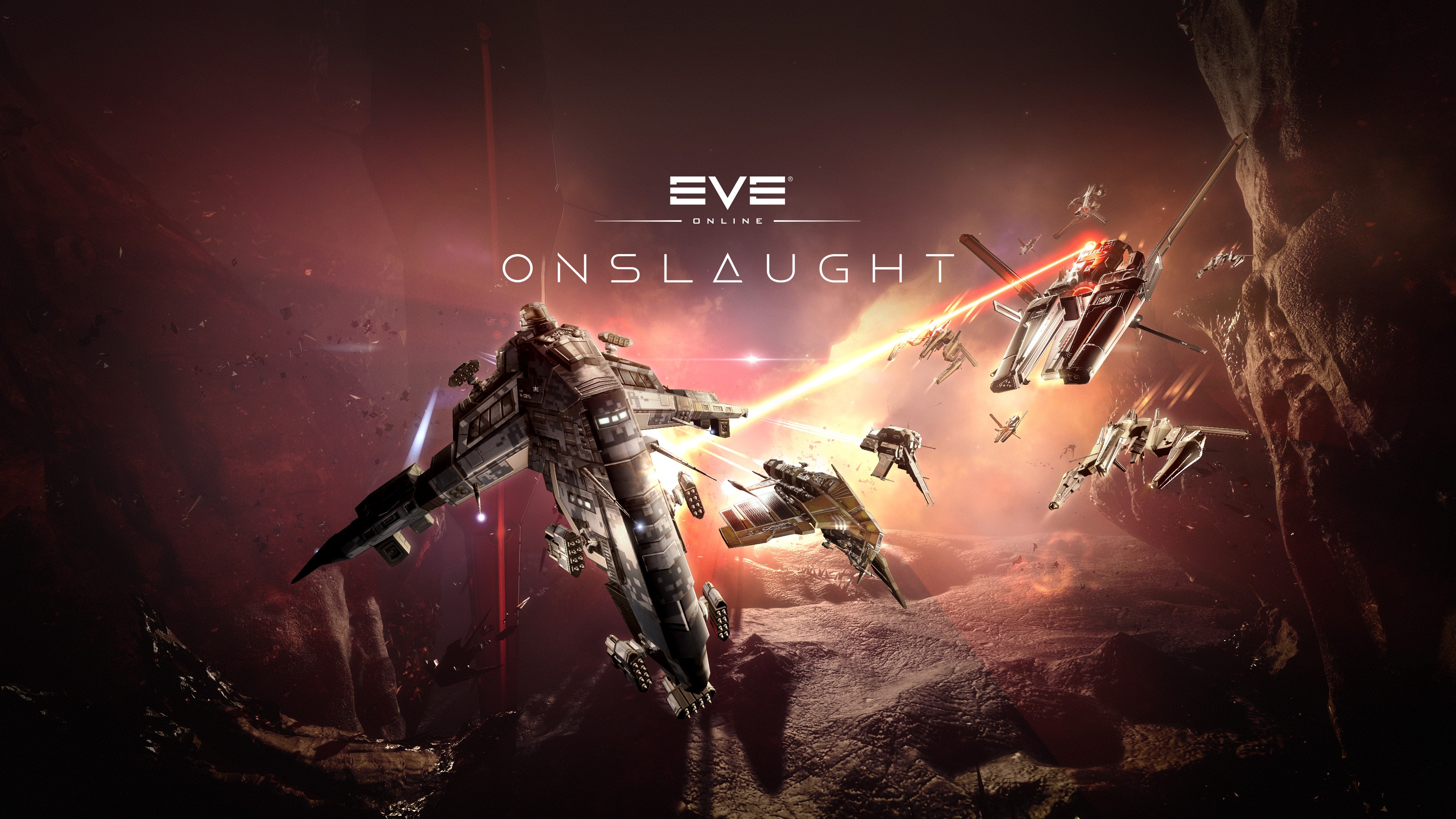
Image: CCP Games · Fan-content policy: https://www.eveonline.com/news/view/eve-online-fan-content-policy
Player-built Ansiblex Jump Gates anchor inside null sov systems, restoring some of the long-distance projection that Phoebe limited.
Onslaught - what changed
Background
Onslaught (2018-11-13) is the post-Phoebe answer to nullsec mobility. Phoebe (2014) had killed unrestricted long-range jumping with jump fatigue; for four years, nullsec coalitions lived with the constraint. Onslaught introduced the Ansiblex Jump Gate - an Upwell navigation structure deployed in matched pairs up to 5 LY apart, fatigue-free for sub-supercapital ships - and rewrote the post-Phoebe geography.
It also shipped the Tenebrex Cyno Jammer and Pharolux Cyno Beacon as a pair, replacing the old POS cyno-jammer/beacon arrangement and giving nullsec coalitions per-system cyno control. T2 Triglavian hulls weren't yet here (those arrive with Invasion in May 2019), but the Force Auxiliary balance pass and a stack of structure changes shipped alongside the headline navigation work.
What changed, by playstyle
PvP
If you played EVE before 2014 and remember unrestricted jump-bridge nullsec, then walked away after Phoebe locked everything down, Onslaught is the day the lock came off - partially. Ansiblex Jump Gates let sub-supercaps cross 5 LY without fatigue, paired structures only, and your coalition's logi pilots are now hauling Liquid Ozone instead of just fuel blocks. The Tenebrex Cyno Jammer + Pharolux Beacon pair gave you per-system cyno control - drop me, but only where I let you. The 2018-2024 era of nullsec power-projection is the era these structures defined.
Industry
Onslaught isn't usually framed as an industry expansion, but for nullsec industry it is one. Ansiblex jump gates created a recurring high-volume product - gates wear out, get killed, and burn Liquid Ozone every jump - that defined six years of nullsec logistics until Equinox in 2024 swapped the whole sov-structure stack out. Liquid Ozone in particular is the heir to Heavy Water from the POS era: a boring high-tonnage consumable that bankrolled mid-tier industrialists for the rest of the decade.
Social / political
Onslaught is the expansion that defined the geography of nullsec coalition politics for the next six years. Ansiblex highways became the literal map: you knew where Goonswarm staged because you knew where their gates were. The Tenebrex/Pharolux pair gave alliances "my cyno yes, your cyno no" mechanics at the system level. If your last memory of EVE was the Phoebe-era lockdown of 2014-2018, Onslaught is the moment that lockdown got partially undone - but only for groups that could afford the gate web. Six years later, Equinox would tear the whole sov-structure stack out and start over.
Aftermath / what stuck
Ansiblex usage is gated by Liquid Ozone consumption - Ozone = (mass kg) × (distance LY) × 0.000003 + 50 - which rapidly became the bill-of-materials line item that mattered most for a nullsec coalition's logistics. The gate web defined coalition footprints through WWB2 (2020-2021), the entire late-Phoebe coalition era, and the six years of nullsec power-projection that followed. Equinox (June 2024) reshaped this: Ansiblex jump gates and Sov-Hub upgrades now share a Power budget, so coalitions can run fewer gates per system than the pre-Equinox arrangement. The 2018-era Onslaught geography is no longer the exact geography of 2026, but its DNA is everywhere on the nullsec map.
What changed for you
compare across expansions ->Top picks · highest impact across all playstyles
-
5
Social
Coalition footprints redrew themselves around Ansiblex highways - staging systems, capital lanes, and force-projection windows are all defined by where the gates are, so nullsec politics took on a new geography for the next six years.
-
4
PvP
Ansiblex Jump Gates rewrote the post-Phoebe nullsec map - paired Upwell structures up to 5 LY apart let sub-supercapital fleets cross constellations without jump fatigue, restoring the kind of strategic mobility nullsec lost in 2014.
-
4
Industry
Ansiblex / Tenebrex / Pharolux blueprints are a major new T2-tier industry product - Ansiblex BPCs, components, and Liquid Ozone consumption created a recurring industry pipeline that lasted the next six years until Equinox reshaped sov.
All changes by playstyle (13 changes across 3 playstyles)
-
4
Ansiblex Jump Gates rewrote the post-Phoebe nullsec map - paired Upwell structures up to 5 LY apart let sub-supercapital fleets cross constellations without jump fatigue, restoring the kind of strategic mobility nullsec lost in 2014.
caveat
Ansiblex usage is gated by Liquid Ozone consumption: Ozone = (mass kg) × (distance LY) × 0.000003 + 50.
-
4
Tenebrex Cyno Jammer + Pharolux Cyno Beacon pair replaced the old POS-mounted equivalents - a coalition can jam a system to incoming cynos in 5 minutes, but only one of up to three Tenebrexes per system can be active at a time.
caveat
Two distinct structures often discussed as one feature: Tenebrex (jammer) shuts down hot-drop projection; Pharolux (beacon) defines coalition cyno destinations.
-
3
Force Auxiliary capital ships were rebalanced, shifting the rep-cradle math; Apostle / Lif / Minokawa / Ninazu numbers changed enough to alter capital fleet composition for the next year of nullsec PvP.
-
3
Triglavian T1 Drekavac / Rodiva entered service - the wider Triglavian hull line continued to expand small-gang doctrine options, on top of the Damavik / Vedmak / Leshak that shipped with Abyss.
-
3
Mobile Cynosural Inhibitor deploy time cut to one minute and volume reduced to 50m3 - a small QoL change with outsized PvP value: anti-hot-drop counter-play actually fits in a logi alt's hold now.
Industry
Industry across all expansions ->-
4
Ansiblex / Tenebrex / Pharolux blueprints are a major new T2-tier industry product - Ansiblex BPCs, components, and Liquid Ozone consumption created a recurring industry pipeline that lasted the next six years until Equinox reshaped sov.
-
3
Liquid Ozone became the new high-volume nullsec consumable - every Ansiblex jump burns Ozone proportional to mass × distance, so industrialists now sell Ozone the way they used to sell Heavy Water for POS.
-
2
Triglavian T1 invention pipeline: precursor blueprints, Triglavian datacores, and the recipe chain for Damavik/Vedmak/Leshak/Rodiva/Drekavac stabilised as a real production line - small but novel industry sector.
-
2
Force Auxiliary rebalance shifted the relative value of Apostle / Lif / Minokawa / Ninazu hulls and their build chains - second-order industry impact, but enough to move blueprint pricing in late 2018.
-
5
Coalition footprints redrew themselves around Ansiblex highways - staging systems, capital lanes, and force-projection windows are all defined by where the gates are, so nullsec politics took on a new geography for the next six years.
-
3
Per-system cyno control via the Tenebrex/Pharolux pair gave alliances genuine "home turf" mechanics - you can now deny hot-drops at the same systems where you allow your own friendly cynos to land.
-
3
Structure-permission management got more granular - the Ansiblex / Tenebrex / Pharolux structures all use the Upwell access-list system, so corp/alliance director workload around structure permissions stepped up.
-
2
Big-block coalitions were the natural beneficiaries of Ansiblex - small alliances couldn't afford the gate webs and got squeezed; the long-term effect was visible in the World War Bee 2 power blocs of 2020-2021.
caveat
Editorial framing well-attested in TAGN/EN24 retrospectives but one-step-removed from patch-notes content.
Impact score 1-5 (5 = paradigm shift for that playstyle).
Economy at this date
Monthly Jita PLEX averages from EVE Ref; MER metrics extracted from CCP's Monthly Economic Report archives. See /economy for the full series.
Sources
- EVE Online - Onslaught to be deployed November 13
- EVE Online - Navigation Structures Inbound (Ansiblex)
- EVE Ref - Ansiblex Jump Bridge specs
- CCP patch notes
- CCP Onslaught deployment info
- Updates archive landing
- Updates card - Ansiblex Jump Gate
- Updates card - Tenebrex Cynosural Jammer
- EVE-Uni wiki - Navigation structures
- EVE Ref - Tenebrex Cyno Jammer
- TAGN preview
- EVE News 24 patch notes