·event MAJOR
The Battle for Providence (2010): The First Fall of the NRDS Empire
In early 2010 Against ALL Authorities and its Southern Coalition allies broke the Curatores Veritatis Alliance and took most of Providence, the first fall of a capsuleer holder-empire. A holder-ally land-grab in Catch lit the fuse; the collapse of Goonswarm freed AAA to swing south; and a capital slaughter at D-GTMI, decided by spy-leaked tower passwords and crippling server lag, broke the defence. By April the last stations had fallen, and CVA's army of role-players had been ruled a dinosaur.
The Battle for Providence (2010): The First Fall of the NRDS Empire
For five years the Curatores Veritatis Alliance had done the impossible. It held the most-settled conquerable region in EVE, fifty player stations across eighty-three systems, under a doctrine the rest of null-sec considered suicidal: Not Red Don't Shoot, an open door that welcomed neutral pilots rather than killing them on sight. It defended that open door with an army of volunteer role-players, and it refused, on moral grounds, to spy, to metagame or to hire mercenaries who would not play the part. In the first months of 2010 a hardened sovereignty power put all of that to the test at once, and broke it. The Battle for Providence was the first time a capsuleer holder-empire fell, and the way it fell, station by station, in a doomsday-lit capital massacre and a refused ceasefire, is the story of how the dinosaur died.
The dinosaur and its garden
By the end of 2009 Providence was the friendliest patch of null-security space in EVE, and that was entirely CVA's doing. The alliance led the Providence Holders Coalition, the cluster of allied alliances the wider game called Provi-Bloc, and it ran the region on Not Red Don't Shoot. Almost every other null-sec bloc ran the opposite doctrine, Not Blue Shoot It, where anyone not an explicit ally is a target. CVA welcomed neutrals into its space to mine, rat and pass through, hunting only the pirates and the flagged reds on its public kill-on-sight list. A brand-new pilot could undock into Providence and survive, which was true nowhere else in nullsec.
The doctrine came with a code of honour that the rest of the game had quietly abandoned. CVA defended its home with role-players rather than career sovereignty PvPers, and it would not spy on its enemies, would not metagame, would not bring in mercenaries who were only in it for the ISK. Those tactics had been the height of fashion when CVA formed in 2007, and they had been selected against in the brutal evolutionary years since. CVA kept them anyway, because keeping them was the point. Holding a useless region cheaply, surrounded by megalliances, was the whole proof-of-concept: an empire that ran on principle rather than overwhelming force.
What made it possible was that Providence had been worthless. For years its low value had been its security - a region nobody wanted was a region nobody attacked, the perfect quiet yard in which to build supercapitals. Then in December 2009 the Dominion expansion changed the rules of sovereignty underneath CVA's feet. Owning stations and systems suddenly mattered: infrastructure hubs, development indexes, the ability to rent space out, all turned territory into income. At the same time Dominion made the starbases that built supercapitals vulnerable in ways they had not been. The quiet yard was now both lucrative to take and dangerous to keep, and the security model that had protected Providence for half a decade evaporated overnight.
The spark: Libertas Fidelitas and the Catch land-grab
The war did not begin as an attack on CVA at all. In the second week of January 2010, the holder alliance Libertas Fidelitas - a CVA ally, acting under the coalition's expansionist Operation Deliverance - moved into lower Catch and dropped sovereignty structures on four unclaimed systems: F9E-KX, SV5-8N, WD-VTV and 9KOE-A. The systems had only recently been de-sovereigned, and the power that considered them its own was Against ALL Authorities, the alliance leading the Southern Coalition.
Roughly six hundred Providence-friendly pilots mobilised behind the move, and a Holder fleet some three hundred ships strong knocked the station services offline in HED-GP. AAA demanded the Catch systems back. The Holders refused. So AAA went to war - not, at first, against CVA, but against the ally that had grabbed its space and the coalition standing behind it. The timing was the worst imaginable for the defenders, because AAA was at that moment looking the other way entirely, deep in a fight against its oldest rival in the southwest.
Two fronts become one: the Goonswarm collapse
Then the rival vanished. At the start of February 2010, Goonswarm collapsed from the inside - dissolved over lapsed sovereignty upkeep in the Karttoon disbandment, half a trillion ISK and an alliance walking out the door. AAA had spent the better part of a year tied up against Goonswarm in the southwest, and the moment that front evaporated, every fleet commander and every capital that had been committed there was suddenly free.
AAA swung the whole Southern Coalition south. Its allies came with it: the Minmatar-rebel Ushra'Khan, fighting on AAA's side here even as its own alliance was imploding from the Tarac Nor betrayal that same year, along with Systematic Chaos, Star Fraction, AAA Citizens and, soon, the heavyweight ATLAS. AAA ejected Libertas Fidelitas from the contested Catch systems, and then it did not stop at the border. It carried the war into Providence itself. The two fronts had become one, and the freed Southern Coalition now outweighed anything the Holders could field.
D-GTMI: the night the capital fleet died
The hinge of the whole campaign was a single capital battle, and it was a slaughter. AAA struck at D-GTMI, a Providence system held by the holder-alliance Paxton Federation. To defend it, a CVA and Holder capital fleet - upward of one hundred and forty capitals and more than six hundred pilots in total - titan-bridged in.
They bridged into a trap. AAA had pre-positioned roughly thirteen titans and somewhere between sixty and eighty dreadnoughts, and it had something the Holders' code of honour had told them never to use: intelligence. A spy had leaked the passwords to the defenders' starbase forcefields. That single piece of leaked information was the whole battle. A starbase forcefield is the safe harbour a capital fleet brings to a fight - the bubble you anchor under, repair inside, and dock your supers behind when the field turns against you. With the passwords in hand, AAA did not have to break that harbour; it simply walked through the door. When the Holder capitals arrived, AAA bubbled the friendly tower they expected to shelter under, trapping the capitals outside the shield they could no longer enter, and the titans opened up with doomsday devices on the caps caught in the open. A doomsday device in this era was a single, devastating titan weapon, and a wall of them firing into immobilised, bubbled capitals is not a battle so much as an execution. On top of the ambush came the other combatant nobody could fight: the server. Catastrophic node-lag and system failures crippled the Provi fleet, modules refusing to cycle, ships refusing to align, commands swallowed for minutes at a time. The defenders were doomsday'd in slow motion, unable even to issue the orders that might have saved a few hulls.
CVA lost, and the two contemporaneous explanations for why have never quite been reconciled. CVA blamed the server, the "spatial anomalies" and node failure that gutted its fleet at the critical moment. The Ushra'Khan, on the attacking side and watching the defence fall apart, blamed Provi command decisions instead - the choice to bridge into that system, under that tower, at that moment. Both framings are true to their sources, and both are preserved here. Whatever the cause, the D-GTMI station was reinforced, and on the last day of January AAA's Manfred Sideous issued a public address framing the entire Catch incursion as the betrayal that had forced AAA's hand. The capital fleet that was supposed to hold Providence was wreckage.
The ceasefire CVA refused
With D-GTMI in hand, AAA offered terms. It proposed a seventy-two-hour ceasefire and a treaty: AAA would return D-GTMI to Paxton Federation and halt the invasion of Providence, in exchange for CVA forswearing any future attacks on AAA's Catch sovereignty. It was, by the brutal arithmetic of the war, a generous offer - the attacker volunteering to stop with most of Providence still in Holder hands.
CVA's executor Aralis refused it. CVA would not place itself beneath AAA, would not accept terms dictated by a conqueror, would not trade its principles for its safety. The refusal was honour, and it was fatal. It split the Providence Holders down the middle, between those who wanted the peace they had just been offered and those who wanted to fight on, and the fracture freed AAA to finish the job at leisure. Libertas Fidelitas, the ally whose Catch land-grab had started the whole thing, was barred from offensive operations entirely. The defenders had been offered a way to keep most of their home, and their own code had told them to say no.
The cascade: system by system
After the refused ceasefire, Providence came apart in pieces. The Ushra'Khan struck first and most symbolically: on 8 February 2010, fielding more than four hundred pilots and supercapitals, it recaptured 9UY4-H, the system it had built its fortress in years before and lost, calling the recapture "Deliverance Reclaimed." Sovereignty flipped the next day. That single system's long story - the building of Unity Station, its losses and recaptures and its eventual fate - has its own telling in this archive's Unity Station entry.
The Holders bled out from within as much as from without. In February the holder-alliance Aegis Militia self-destructed over a botched leadership succession, fumbling a sovereignty transfer and losing six systems in the chaos before clawing four of them back. On 28 February ATLAS deployed in full, vowing to burn down Providence the way it had burned Geminate, while Sev3rance and Cold Steel Alliance anchored the western defence. And thr region kept falling. By the middle of March a war correspondent declared the military outcome settled: nine of Providence's fifty station systems were in AAA hands, CVA had shed something like two hundred and fifty members and Libertas Fidelitas eight hundred more plus eight corporations, and no outside null-sec power came to CVA's aid, because its historically poor relations with everyone meant it had no one to call.
On 13 March the dominoes fell in a single day - Y-MPWL to AAA, G-5EN2 to the Ushra'Khan, R3-K7K to Systematic Chaos, 9-F0B2 to ATLAS, the last defended by Fidelas Constans. Manfred Sideous announced that some twenty alliances were lined up to repopulate the region, because the point was never to rule Providence. AAA did not want a holder-empire of its own. It wanted Providence kept open as a sparring ground, a place for small groups to fight over without any one of them locking it down. By 11 April resettlement was underway, small alliances like Agony Empire and Sodalitas XX moving in, and Libertas Fidelitas declared independence from CVA. Then, on 18 April 2010, CVA lost its last thirteen stations in three days. Every CVA station system was gone. The first capsuleer holder-empire had fallen.
The dinosaur's eulogy
CVA vowed to fight on guerrilla-style and swore it would never be removed from what it still considered home - a promise the alliance would spend the next fifteen years half keeping, exiled and returning more than once. But in the spring of 2010 the verdict was in, and it was both brutal and, underneath the brutality, admiring. The problem, the post-mortem ran, was precisely the thing that made CVA special. It was the only major space-holding alliance defending its home with an army of role-players rather than hardened sov-PvPers, and it had absolutely refused to spy, to metagame, or to bring in non-role-playing mercenaries, on moral grounds. Those honour-bound tactics had been fashionable in 2007 and selected against ever since. The verdict was famous and unsparing:
It's a bitter pill to swallow, but CVA is a dinosaur that has not adapted well to the changes that have taken place in EVE Online over the past few years.
And yet the same correspondent who called it a dinosaur wrote its eulogy in the same breath, and meant every word:
Let it not be said that CVA was a failed experiment. It did something that no other alliance in EVE managed to do, despite some serious handicaps. It managed to thrive and profit in a useless region, surrounded by unstoppable megalliances, without compromising its roleplaying character, open-access ideals, or paying tribute to protectors.
That is the paradox the Battle for Providence leaves behind. CVA lost because of exactly what made it worth caring about. A hardened NBSI bloc with spies, metagame and hired guns beat an open-door empire of role-players who would use none of those things, and the open-door empire was ruled obsolete for it. But the dinosaur was not a failed experiment, and it did not stay dead. Its enemies hired spies; CVA never did, and held the region on and off for two decades anyway. The first fall of the NRDS empire was not the end of the experiment. It was the proof that the experiment was real enough to be worth killing - and resilient enough to survive being killed.
Returning player note
The Battle for Providence in 2010 was the first time a player-built holder-empire fell in EVE, and it is a clean case study in how null-sec sovereignty wars are actually won: not by the bigger fleet alone, but by a leaked starbase password, a doomsday ambush on bridged-in capitals, a refused ceasefire, and the server itself buckling under the load. The Curatores Veritatis Alliance lost most of Providence because it defended an open-door region with role-players and refused to spy or metagame on principle, against a hardened coalition that did all three. It is the foundational example of the metagame deciding a war that the fleets alone would not have.
Providence is still there, and it is still fought over - that never stopped. Curatores Veritatis Alliance reclaimed the region in 2024 and 2025, on contested terms, and it still runs the same Not Red Don't Shoot doctrine it died for in 2010, so neutral pilots are genuinely welcome rather than shot on sight. If you want to see where the dinosaur died, you can fly out to Providence today: it remains open null-sec under NRDS rules rather than a blue-blanket coalition, a small-gang content hub with enemies always passing through. Check the standings before you undock, and expect a fight.
Campaign stats
Against ALL Authorities + Southern Coalition operation- System
- D-GTMI · Providence
- Sides
-

Against ALL Authorities
Anchor
On side: Against ALL Authorities + Southern Coalition

Ushra'Khan
Partner
On side: Against ALL Authorities + Southern Coalition
Curatores Veritatis Alliance
Anchor
On side: Curatores Veritatis Alliance + Providence Holders
Sev3rance
Partner
On side: Curatores Veritatis Alliance + Providence Holders
Fidelas Constans
Partner
On side: Curatores Veritatis Alliance + Providence Holders
- Decisive doctrine
- AAA titan-bridged a capital fleet into D-GTMI, used spy-leaked tower passwords to bubble and doomsday the Holder caps, and crippling node-lag finished the rout.
Caveats & contested numbers
No ISK-destroyed figure survives for this campaign. No contemporaneous source published a campaign-wide or single-battle ISK total, so none is shown here rather than reconstruct one.
The membership-loss figures - CVA losing roughly 250 members, Libertas Fidelitas roughly 800 members plus eight corporations - come from a single mid-March 2010 estimate by one war correspondent and are best read as that writer's contemporaneous reckoning rather than an audited count.
The D-GTMI capital loss has two contemporaneous framings that have never been fully reconciled. CVA blamed the server: "spatial anomalies" and node-lag that gutted its fleet at the decisive moment. The Ushra'Khan, on the attacking side, blamed Provi command decisions - the choice to bridge in where and when it did. Both are preserved as reported; the truth is probably some of each.
The Ushra'Khan recapture of 9UY4-H ("Unity Station") on 8 February 2010 is part of this campaign but has its own fuller telling on the Unity Station entry.
Killboard
via zKillboard-
-
Curatores Veritatis Alliance alliance
Corps 31 ISK Dest 117.09 T K:D 2.32 Eff 78.8%
-



Gallery
Sources
- CCP IC - The Providence War: Part I, Catch an Easy Prey (Svarthol, Feb 2010)
- CCP IC - The Providence War: Part II, Two Fronts Become One (Svarthol, Feb 2010)
- CCP IC - The Providence War: Part III, Internal Struggle (Svarthol, Feb 2010)
- CCP IC - The Providence War: Part IV, The Return of Unity (Svarthol, Feb 2010)
- CCP IC - Failed Sovereignty Transfer Leads to Conflicts Over Six Systems (the Aegis Militia collapse)
- CCP IC - ATLAS Deploys in Providence (28 Feb 2010; the western-front escalation)
- CCP IC - Providence Holders Lose Four Systems, AAA Announces Plans (13 Mar 2010)
- CCP IC - Providence Resettlement Continues (11 Apr 2010; small alliances move in)
- CCP IC - CVA and Allies Vow to Continue Fighting As Last Stations Fall (18 Apr 2010)
- Ten Ton Hammer - The Battle for Providence in EVE Online (Space Junkie, 16 Mar 2010)
- EVElopedia - Curatores Veritatis Alliance (period-locked CVA history; the 2010 war)
- kugutsumen.com - CVA Actually Does Something thread (attacker-side, Jan-Feb 2010; Wayback)
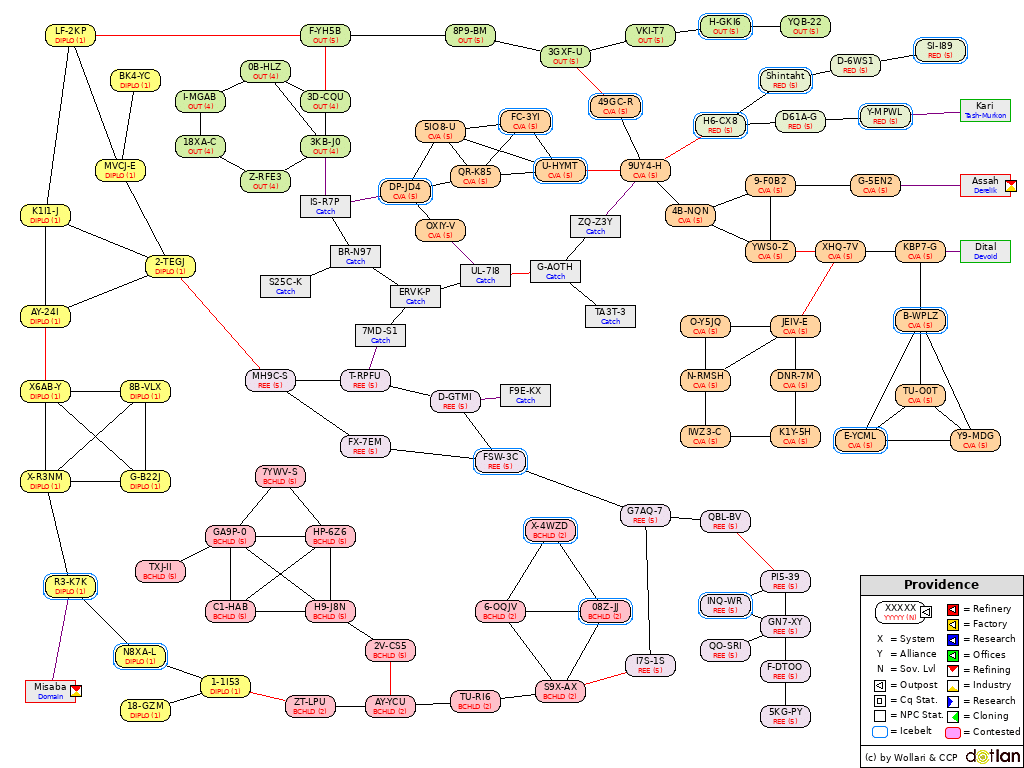
- DOTLAN EVE Maps - Providence region (system / constellation topology reference)
Related
-
Jan 2018
The Fall of Provi-Bloc (2018): PanFam, the Faction Fortizars, and the Exile
-
Aug 2014
The HERO War (2014): When the Newbies Came for Providence
-
Jan 2014
Battle of B-R5RB
-
Feb 2010
The Karttoon Disbandment: Half a Trillion ISK and an Alliance Walked Out of Goonswarm (2010)
-
Jul 2006
The Saga of Unity Station
-
Nov 2004
Curatores Veritatis Alliance: The Providence Holdout
-
Nov 2004
Ushra'Khan: EVE's Oldest Alliance