·event MAJOR
The Industrial Terrorist: Helicity Boson and the Hulkageddon Years (2009-2012)
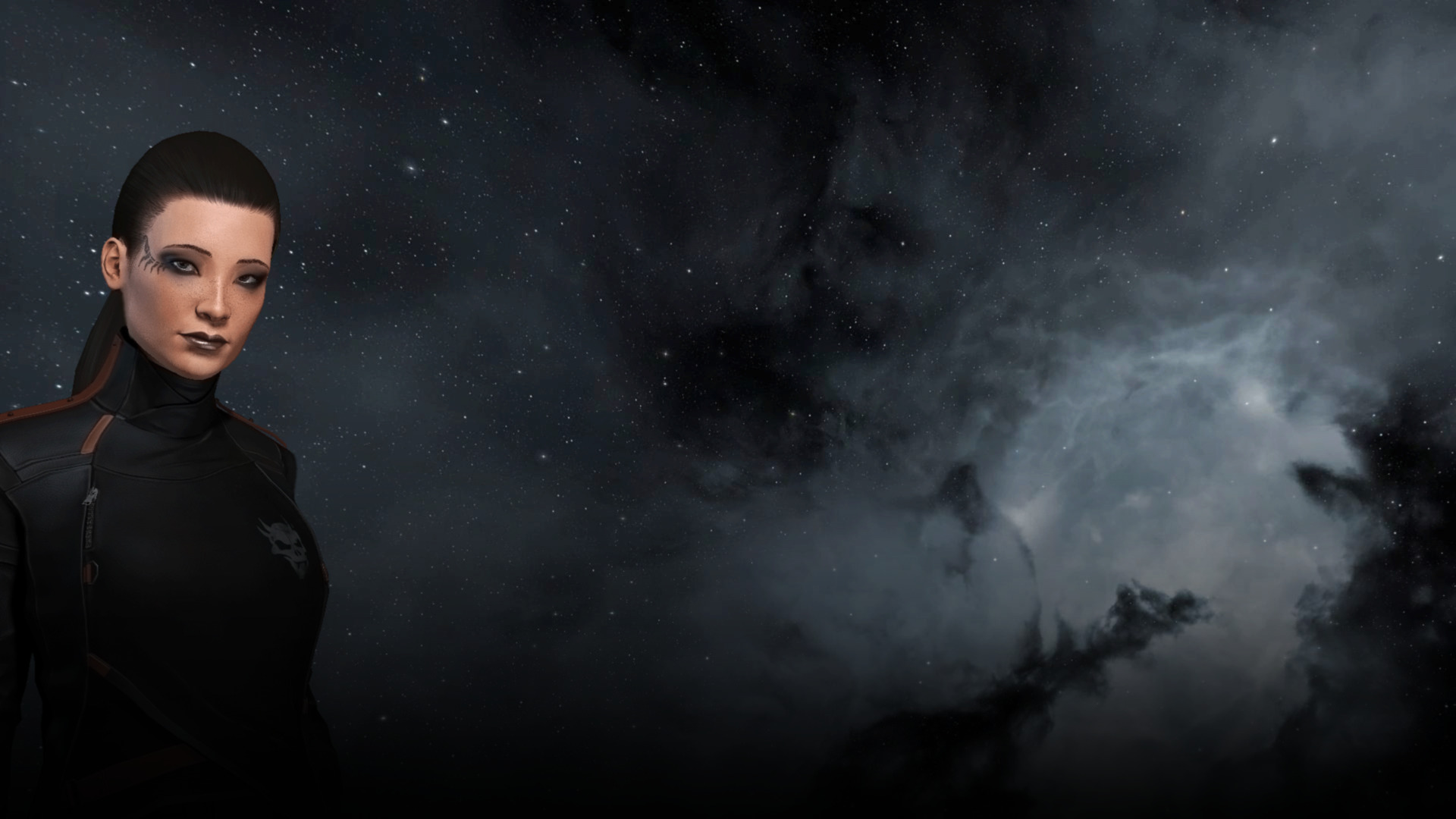
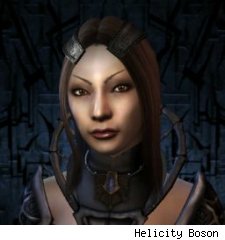
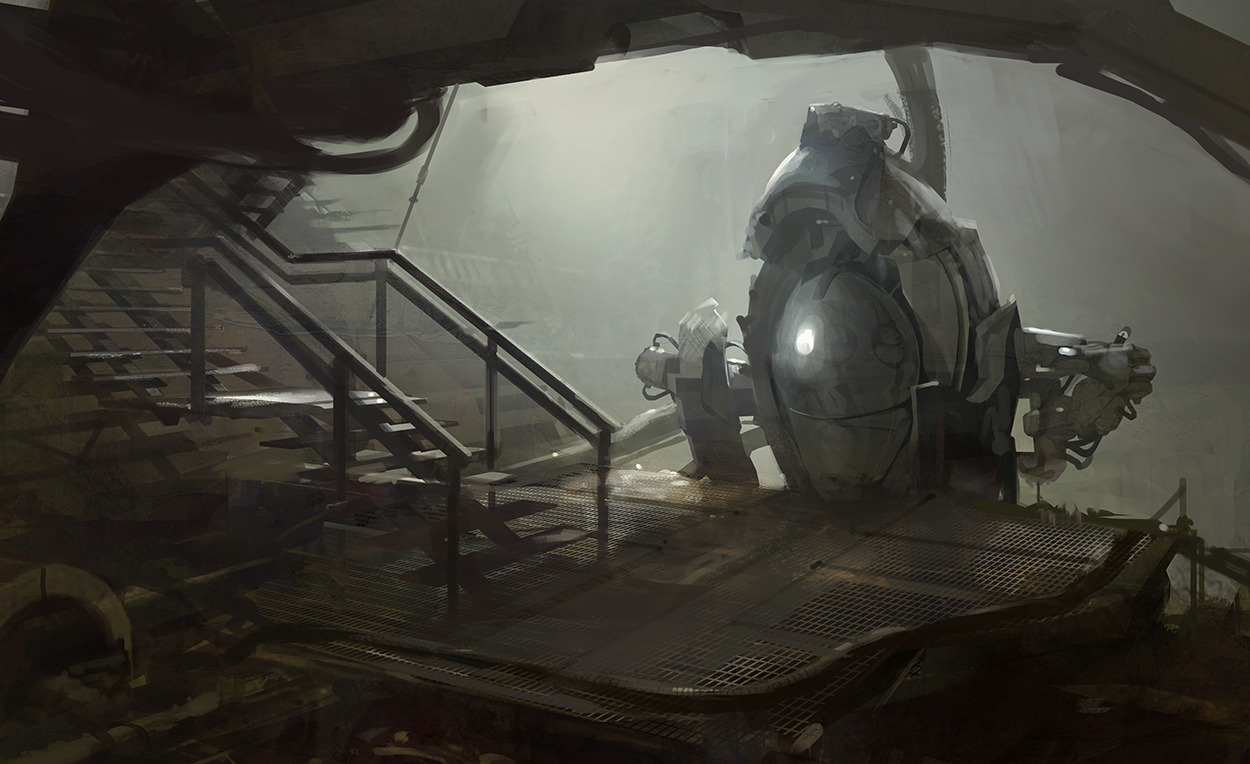
Image: CCP Games / Helicity Boson composition · (c) CCP Games (used under CCP fan-content policy)
Helicity Boson founded Hulkageddon in October 2009 as a 72-hour highsec gank tournament; five iterations through 2012 turned it into the template for organised highsec griefing. Banned in June 2011 for unlocking the redactions on CCP's internal Fearless magazine - the fuse-light for the Incarna player riots and the Summer of Rage. Unbanned within months; returned to active EVE in August 2023.
The Industrial Terrorist: Helicity Boson and the Hulkageddon Years (2009-2012)
Background
Helicity Boson's EVE account opened in 2007. The character that would later become a household name in EVE press was rolled some time after, around early-to-mid 2009, after a false-start phase of trying mainstream PvE content. As Helicity later told James Egan in the canonical community-spotlight interview of the era: "I tried PvE briefly but quickly got bored of it and quit playing the game." What pulled them back was Spectre3353's blog. Spectre3353 was a member of The Python Cartel, a small but loud lowsec pirate outfit; his writing made the corp's daily small-gang piracy sound a lot more interesting than the mission-running treadmill that had bounced Helicity off the game the first time.
Helicity rolled a new character, dropped into The Python Cartel's public channel, and asked to join. Spectre3353 let them in. From that moment on Helicity treated piracy not as a playstyle but as a craft, and the corp's lowsec roaming rhythm was the platform from which a wider idea began to take shape: that the EVE community had been waiting too patiently for somebody else to make highsec interesting.
The structural precedent for what Helicity would build was Jihadswarm, the Goonswarm-internal highsec ganking outfit that had run organised suicide ops against mission-runners and freighter pilots since 2007. Jihadswarm proved highsec ganking could be organised at scale; what it never proved was that the rest of EVE's scattered pirate corporations could be persuaded to cooperate with each other on anything, ever. Pirate corps in 2009 had a near-religious tradition of mutual suspicion and uncoordinated freelancing. Hulkageddon was Helicity's attempt to force them, against type, to coordinate for one weekend.
Featured persona - The Industrial Terrorist (Helicity Boson)
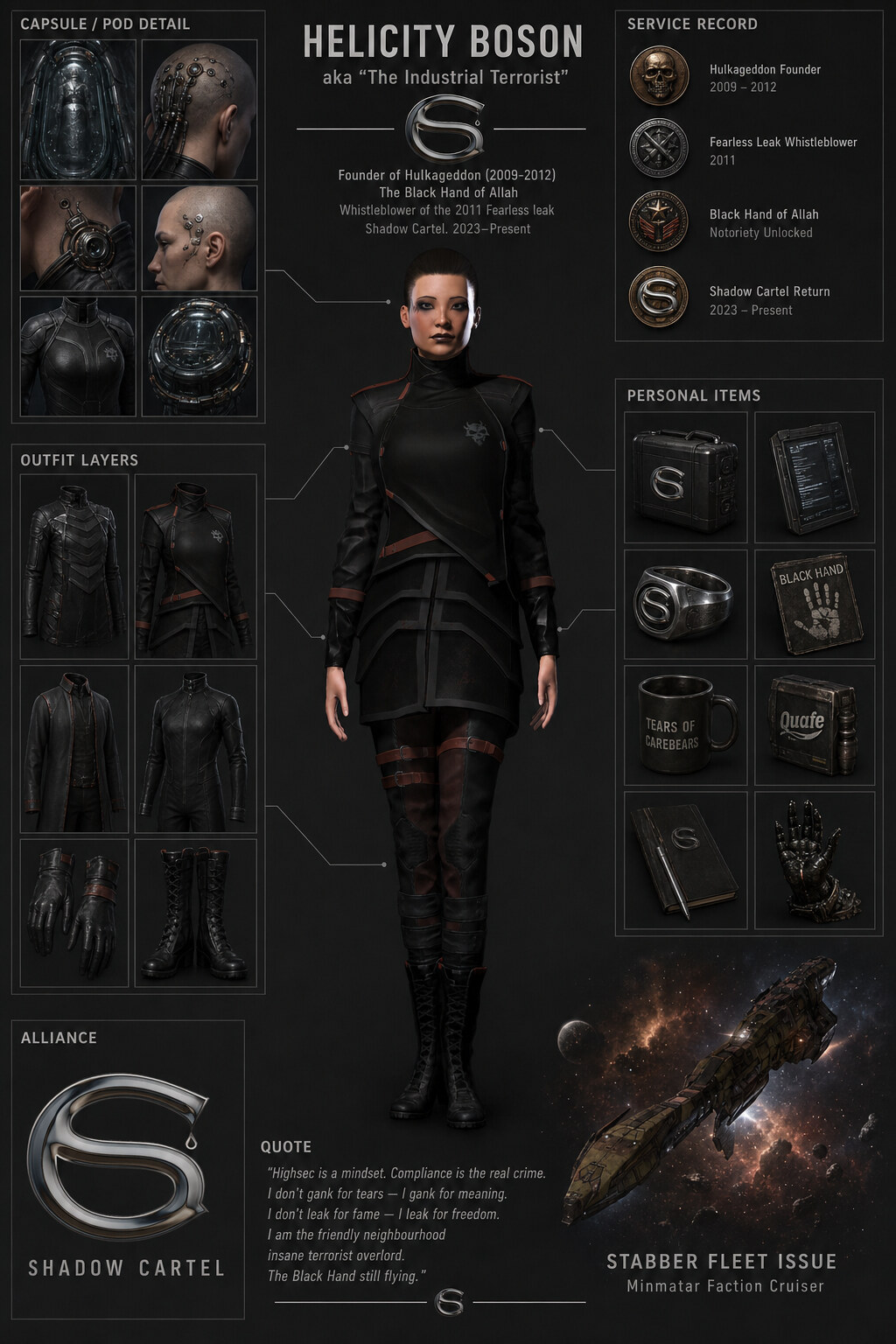
The character was created on 3 August 2008, fifteen months before the first Hulkageddon. The persona - 'industrial terrorist', 'the Black Hand of Allah', 'friendly neighbourhood insane terrorist overlord' - was assembled across her 2009-2012 press coverage and locked permanently into the in-game character bio. The dry title 'E-Famous? I've hardly mentioned it.' is her current sign-off; the homepage URL points at helicityboson.com, which still routes.
The Hulkageddon I idea
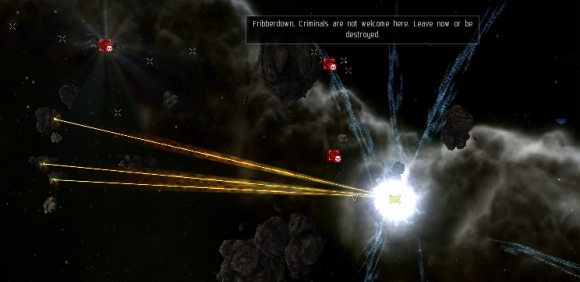
The first Hulkageddon ran the weekend of 16-19 October 2009. The format was simple: a 72-hour open-entry tournament where any participating corporation could rack up points by destroying highsec mining vessels, with cash prizes for individual top killers funded by donations from Garmon and El'Tar. The target list was deliberately bounded to exhumers and mining barges - the most expensive and slowest mining hulls, the ones whose pilots were most likely to be AFK and least likely to be paying attention to local. Around eighteen corporations signed on, which was, as Helicity put it later, the actually-hard part of the project.
"There's really a strong tendency among pirate groups not to cooperate at all - which is probably the most defining feature of being a pirate group. So Hulkageddon was very much started as just something I did on a whim."
By the end of the weekend the participants had destroyed sixty-six exhumers, twenty-two mining barges, and twenty-seven pods. CCP IC published a write-up by ISD Deacon York on 29 October 2009 under the headline "Pirate Corporations Band Together for Hulkageddon" - the IC headline itself made it clear that the unusual story was the cooperation, not the gankings. A few days later Helicity posted a thank-you thread on the legacy CCP forums noting drily that "all the hulks we popped the week BEFORE has -large- rigs on them. A clear indication they did not die often enough. So we did something about it."
Going mainstream: the Massively spotlight (January 2010)
The second Hulkageddon ran the full week of 7-14 January 2010 and was the moment the format went from pirate-coordination experiment to press-covered sport. Roughly twelve hundred exhumers and 278 billion ISK in destroyed mining hulls in seven days, an order-of-magnitude jump from H1. ISD Svarthol's CCP IC announcement piece for the event ran with the slightly off-format header "Breaking News: Suicide Attacks Expected to Increase as Hulkageddon II Begins" - and named the organising corporation, in a period-vintage typo, as "The Jerk Cartel" rather than the Python Cartel.
On 26 January 2010, two weeks after H2 ended, Egan published his two-page community spotlight on Helicity through Engadget's Massively MMO column. The piece was the canonical Helicity-voice document of the era and led with this:
"Even the best sandbox MMO will get boring if nobody does anything to make it more interesting. I think I have succeeded in this."
What followed was a deliberate philosophical position laid out in interview form. Helicity framed the project not as griefing but as pedagogy. The press-coverage that occured around the spotlight emphasised this framing more than any of the kill counts:
"I'm trying to teach people they are in a sandbox, they are not entitled to anything."
On the organisational scale-up between H1 and H2, Helicity was clear that it had not been organic:
"I knew it was going to be far bigger than the first event; afterall I did spend the Christmas holiday and the weeks leading up to it making a lot of noise on every medium I could find."
The interview's second page was given over to the highsec-safety controversy. Helicity dealt with the highsec-safety critics by simply restating EVE's mechanics back to them:
"Most of the critics are people that live under the mistaken impression that either: High sec is supposed to be safe (it's not). They are entitled to do something in EVE in complete safety (you're not)."
The line that most interviewers in the years afterwards would quote was the one about the unrealised counter-event. Helicity had hoped, by H2, that a player-organised defence would emerge:
"I was hoping that a 'counter' event would evolve where the so-called 'carebears' would use the tools and mechanics of the game to mount a defense."
It never did. The asymmetry between organised ganking and unorganised victimhood that Hulkageddon exposed turned out to be the durable design fact of EVE's highsec, not a temporary novelty. The "insane pseudo-nuns" framing that Helicity gave the H2 escalation was an in-character joke about how the participating pirate-corps treated the event with monastic devotion; the joke landed because the structural fact underneath it was real.
The Goonswarm sponsorship and Hulkageddon V (2012)
Hulkageddon III ran in July 2010; Hulkageddon IV ran in February 2011. Both followed the H2 template - a week-long format, an expanded prize pool, growing press coverage. H4 was the last iteration that Helicity ran as a solo organiser. By the time H5 was being planned, two things had changed structurally. Helicity was banned. And Goonswarm had decided that organised highsec ganking was no longer a stunt; it was a tool of nullsec economic warfare.
The Mittani laid out the logic in Sins of a Solar Spymaster #78 "The Extortion of Empire" at Ten Ton Hammer in 2011. Goonswarm's nullsec economy at the time was built on technetium - a moon material with a near-monopoly control window that the CFC was extracting at maximum rate. The structural problem was that any drop in mineral prices weakened the technetium-driven income, because mineral prices set the floor on what nullsec rats could earn relative to highsec mining. Mittani's position was that suppressing highsec mineral supply was the same project as defending the nullsec moon-extraction economy. Sponsoring Hulkageddon was, in those terms, a routine industrial-policy decision.
Hulkageddon V ran from 29 April to 30 May 2012, with Goonswarm as primary sponsor. The format scaled accordingly. Goonswarm posted a 100 million ISK bounty for every ten mining-hull kills a participant could prove, on top of whatever cash prizes the traditional Hulkageddon prize pool could muster. The event consumed over seven thousand exhumers and 1.47 to 2.34 trillion ISK in destroyed hulls across five weeks. The numbers were so large that the event functionally stopped being a tournament and started being a war.
That H5 ran without Helicity is itself the load-bearing fact about it. The event had escaped its founder. The community had absorbed the playbook deeply enough that the format continued at coalition scale while its inventor was locked out of the game.
The Fearless leak and the 2011 ban
Friday 24 June 2011 was the night Captain's Quarters went live with Incarna 1.0. It was also the night the New Eden Store launched with the $60 monocle - the highest-priced cosmetic vanity item EVE had ever shipped, priced at PLEX-equivalent values that the player base read immediately as an opening shot in a microtransaction war the previous CCP had promised would never happen.
A sanitised PDF of CCP's internal discussion newsletter "Fearless" had been circulating in player hands by that morning. The specific issue that leaked was titled "Greed is good?", and it had reached players via EveNews24, which had received the file from an anonymous throw-away email account about a month earlier - a leak source that has never publicly self-identified in the fifteen years since. Editor riverini had sat on it for three weeks - he had initially read it as a possible publicity stunt - before publishing it on Wednesday 22 June under the headline "Greed Is Good: Purportedly leaked internal bulletin shows CCP's 'refreshing' new direction." EN24 had further sanitised the file before distribution, adding its own redactions on top of CCP's and password-locking the PDF for download. The leaked PDF carried a feature by Scott Holden called "Delivering the Goods" that laid out a microtransaction roadmap whose target audience was clearly EVE itself: not just vanity items but functional in-game goods, faction standings on sale, ships and modules "purchased outright" with real money.
Helicity unlocked the redactions on the PDF. The defeat was technically straightforward - EN24's owner-password restrictions disabled copy-paste in unmodified PDF readers, but the redactions themselves were overlay objects on still-extractable text.
The unredacted version that hit forums Friday afternoon turned the day's player rage from a clothing-store mismatch into a referendum on whether CCP could be trusted on the boundary between cosmetic and pay-to-win. Mass undocking protests began that evening at the Caldari Navy Assembly Plant in Jita; Stabbs at Stabbed Up reported the system population swelling from a normal ~1,500 to ~2,500 over the course of the night. Paul Clavet's open letter to CCP, quoted in Nosy Gamer's coverage the same evening, captured what the unredacted Fearless had broken:
"The promise that you made to us that real-money transactions would be for vanity items ONLY - that promise is now broken, conclusively and with no possible misinterpretation. You said one thing; you wrote down the opposite. We have the document. There is no walking this back."
CCP banned Helicity that same Friday. The official framing of the ban was that Helicity had been "rude to CCP staff on the forums" - a non-specific framing that the player base was not inclined to accept at face value, given the timing. Both Stabbs and NoizyGamer published "Free Helicity Boson" pieces within hours; both treated the rudeness framing as cover and the leak as the load-bearing cause. The Nosy Gamer piece described Helicity as "a legend" and traced the implausibility of the official explanation directly: hundreds of players were saying worse things about CCP than Helicity ever had, and none of them were banned. The one who had been banned was the one who had broken Fearless wide open.
Three days later the Mittani published an op-ed in The Sins of a Solar Spymaster, the Incarna player riots were running at Jita and at other major hubs across the cluster, and the Summer of Rage was on. Helicity had not started the riots. The microtransaction roadmap had started the riots. But the moment that turned a contained merchandising controversy into a player revolt was the moment the redactions came off the Fearless PDF, and that moment belonged to Helicity.
The Incarna playbook is now permanent EVE history. Captain's Quarters was retired in 2017. The microtransaction roadmap in Fearless never shipped. And the figure who put Helicity in a position to light the fuse was Helicity, not CCP.
Unbanned and out: the long quiet (2012-2016)
The unban came "pretty much immediately", in Helicity's own 2014 EVE-forums framing of the event. By autumn 2013, when GameSkinny's Mat Westhorpe wrote "EVE Online Rogues' Gallery: Helicity Boson, The Industrial Terrorist" for the EVE Online Rogues' Gallery column, Helicity was on the record as "no longer banned and is still a presence within the EVE community". Westhorpe's piece is the canonical retrospective profile of the era.
Helicity continued posting on the legacy CCP forums through 2014-2015, mostly in Crime and Punishment threads and in the Mining-related subforums where occasional misframings of Hulkageddon as a "Concord response-time stress test" cropped up. The exchange with DeMichael Crimson in early 2015 is the corrective: Hulkageddon, Helicity wrote, was not a stress-test of Concord; it was an organised contest presented as one. Concord response times were a constraint on the gank format, not its experimental target. The framing matters because the misframing had a habit of resurfacing in mining-community discussions of why their hulls were dying.
EVEsterdam community meetups in 2014 and 2015 carried Helicity as a recurring attendee. Then, around 2016, Helicity went quiet. There was no public goodbye and no public hiatus announcement. There was simply a slowing-down of posts, a thinning-out of presence, and a few years where the figure who had defined a generation of highsec piracy was not on the boards.
The 2023 return
In August 2023 helicityboson.com relaunched and Helicity posted a brief first-person return note titled simply "test entry":
"Seven years have passed since I last actively played the game and now I'm slowly ramping up towards playing actively again."
A second post on the same day, "_defrost protocol", reframed the seven-year gap in in-character terms as a long cryostasis interval - a clone-pilot returning from cryo, a metaphor that EVE's own lore makes natural and that Helicity used with affection. She introduced the new platform from a distance: a personal site at helicityboson.com, an email at machine9.net, a Twitter handle @helicityboson, a Bluesky handle @helicityboson.bsky.social, and an EVE forums profile (helicity_boson) that has remained quietly active from 2018 onwards through 2024.
Her current corp affiliation is Shadow Cartel - the same lowsec pirate alliance that absorbed much of the original Python Cartel's active membership over the intervening years. She describes herself, on her own contact page, as having "a job and life now" and as the same character "since her inception in the dark past of 2008". The cultural posture is unchanged: Hulkageddon is treated as a question in her FAQ, with the matter-of-fact line that it was an event format that wound down because it had run its course, not because anything was taken from her. The return arc is, in her own words, a gradual ramp-up rather than a comeback tour.
The descendants of what Helicity built are visible across modern EVE. CODE. and its mining-permit shakedowns took the Hulkageddon target list and gave it an in-character ideology. Safety. continued the work after CODE. wound down. Burn Jita's recurring iterations took the coordinated-gank format and applied it to a freighter target list. MiniLuv, Goonswarm's in-house highsec ganking wing, was Hulkageddon's lineal organisational descendant on the coalition side. None of those formats would have existed in their current shape without the proof-of-concept that Helicity ran in October 2009, when about eighteen pirate corps cooperated for seventy-two hours and changed what highsec was for.
Returning player note
If you came back to EVE Online and someone mentions Helicity Boson, this is the figure you're hearing about. Helicity founded Hulkageddon in October 2009 - the 72-hour highsec mining-gank tournament that turned organised ganking from a niche pirate hobby into a press-covered sport. Five iterations through 2012 turned the format into the template for every organised highsec griefing campaign since: CODE., Safety., Burn Jita, MiniLuv. The reason Captain's Quarters lasted only six years and the Fearless microtransaction roadmap never shipped is that Helicity unlocked the redactions on the leaked PDF the night Incarna went live - and CCP banned her for it the same Friday, which is when the player riots really started.
Helicity returned to active EVE in August 2023 after roughly seven quiet years. She is in Shadow Cartel - a lowsec pirate alliance descended from her original Python Cartel home - and is intermittently active on the EVE forums and at helicityboson.com. The Hulkageddon event format itself wound down after V in 2012, but the gank-the-AFK-miner playbook is still alive everywhere highsec gank coordination happens.
Killboard
via zKillboard-
Helicity Boson character
Kills 4,547 ISK Dest 2.56 T K:D 49.42 Eff 99.4%
-
The Python Cartel corporation
Members 1 Kills 888 ISK Dest 31.58 B K/mem 888.0 ISK/mem 31.58 B K:D 1.70 Eff 63.5%
-
Immortalis Inc. corporation
Members 177 Kills 244,279 ISK Dest 94.68 T K/mem 1,380.1 ISK/mem 534.91 B K:D 8.66 Eff 91.6%
-


Gallery
Sources
- CCP IC - Pirate Corporations Band Together for Hulkageddon (Deacon York, 29 Oct 2009)
- CCP IC - Breaking News: Suicide Attacks Expected to Increase as Hulkageddon II Begins (Svarthol, 7 Jan 2010)
- Massively / Engadget - EVE Community Spotlight: Helicity Boson, page 1 (James Egan, 26 Jan 2010)
- Massively / Engadget - EVE Community Spotlight: Helicity Boson, page 2 (James Egan, 26 Jan 2010)
- Wayback - Massively.com original community spotlight (canonical-historical anchor, 7 Nov 2010 snapshot)
- Helicity Boson - Hulkageddon site About page (hulkageddon.wordpress.com)
- Stabbed Up - Eve: Free Helicity Boson (Stabs, 24 Jun 2011)
- Nosy Gamer - A Legend Is Banned From Eve Online (NoizyGamer, 24 Jun 2011)
- GameSkinny - EVE Online Rogues' Gallery: Helicity Boson, The Industrial Terrorist (Mat Westhorpe, 31 Oct 2013)
- eve-search.com - Helicity Boson author archive (1,460 posts across legacy CCP forums)
- eve-search.com - Hulkageddon I thank-you thread (Helicity-voice, October 2009)
- eve-search.com - Crime and Punishment thread 1466538 (Helicity-voice texture, Feb 2011)
- helicityboson.com - Contact page (current handles, character backstory, ban FAQ)
- helicityboson.com - test entry (first-person 2023 return announcement, 23 Aug 2023)
- helicityboson.com - _defrost protocol (in-character return fiction, 23 Aug 2023)
- forums.eveonline.com - helicity_boson profile (Discourse activity 2018-2024)
- Ten Ton Hammer - SoaSS #78: The Extortion of Empire (The Mittani, Goonswarm-Hulkageddon V technetium economics)
Related
-
Jan 2021
Safety. - The CODE. Successor (Princess Aiko)
-
Jun 2012
CODE. and the New Order of Highsec
-
Apr 2012
Hulkageddon V - The Unholy Union
-
Apr 2012
Burn Jita I - Free The Mittani
-
Jan 2012
CaldariPrimePonyClub: The Capsuleer Who Painted EVE Before CCP Did
-
Jun 2011
Incarna - Walking in Stations Goes Live
-
Feb 2011
Hulkageddon IV
-
Jul 2010
Hulkageddon III - Summer of Gank
-
Jan 2010
Hulkageddon II
-
Oct 2009
Hulkageddon I
-
Feb 2007
The T20 Scandal: A CCP Developer Seeded Tech 2 Blueprints to Band of Brothers (2007)